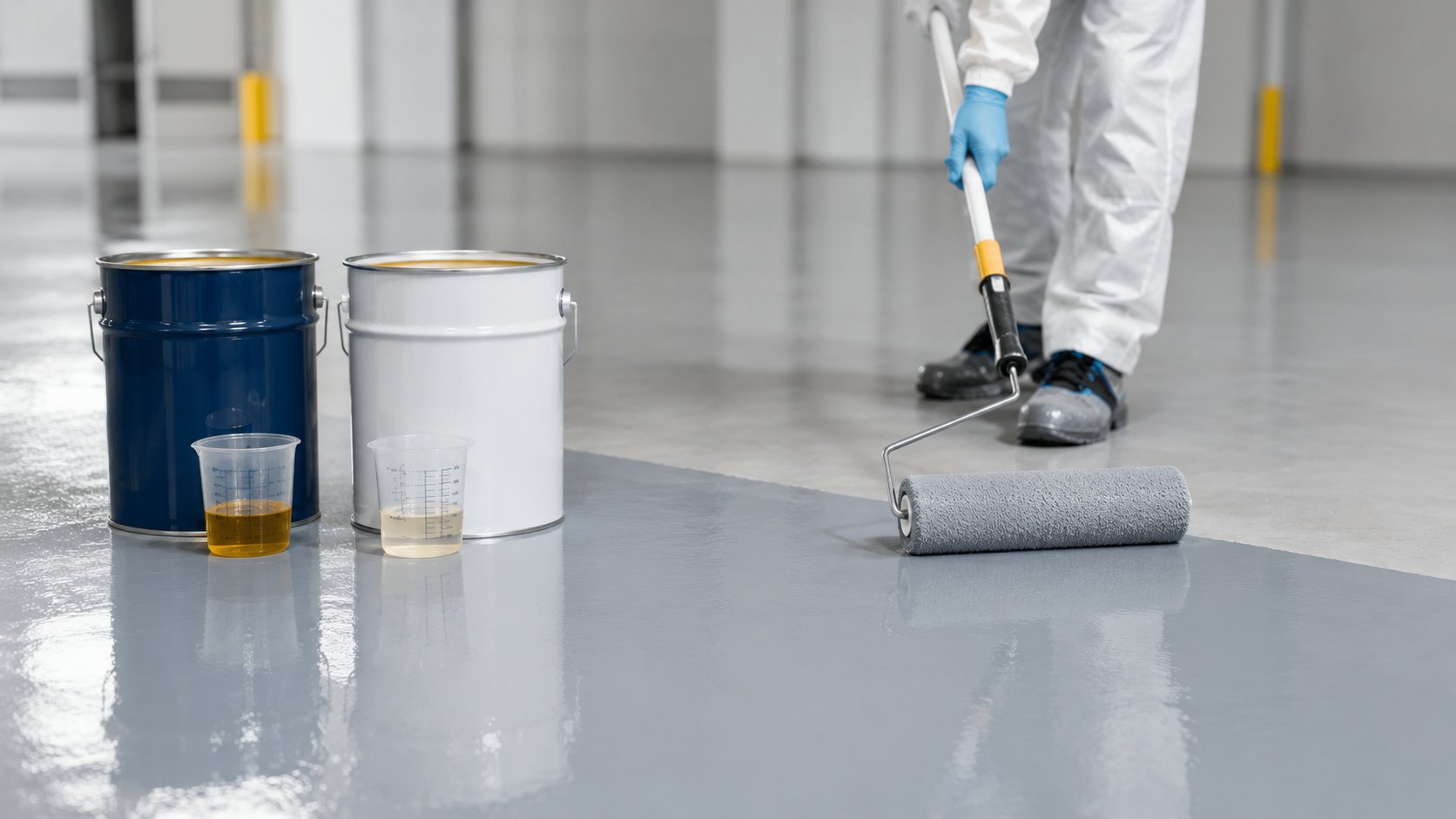
Two Component Polyurethane Coating: Technical Guide for Industrial Use
When a steel structure, a piece of heavy machinery or a busy industrial floor keeps its colour and gloss for years, it is rarely by chance. Behind that durability there is very often a two component polyurethane coating. In this guide we explain how two component (2K) polyurethane coatings work, how aliphatic and aromatic systems differ, where they are used in industry, which site parameters decide the result and what safety obligations apply.
What Is a Two Component Polyurethane Coating?
A two component polyurethane coating is a reactive system supplied in two separate packs that are mixed immediately before application. Component A is a polyol, a resin carrying hydroxyl groups. Component B is an isocyanate-based hardener. Once the two are mixed, a reaction starts that builds a dense, cross-linked polyurethane film on the surface.
Single component (1K) polyurethanes need moisture from the air to cure, so their film build and drying speed depend closely on ambient conditions. In a 2K system the reaction is driven by the components themselves. The result is more controlled curing, higher cross-link density and clearly higher chemical and mechanical resistance.
The first factor that shapes performance is the choice of polyol. Polyester polyols add hardness and chemical resistance, acrylic polyols deliver gloss and colour stability outdoors, and polyether polyols bring flexibility. We look at how polyol type changes film behaviour in How Polyol Selection Determines Polyurethane Performance.
Aliphatic vs Aromatic Systems
The main distinction between two component polyurethane coatings is the type of isocyanate used in the hardener. That choice decides where the coating can be used.
Aliphatic Polyurethane Coatings
Systems cured with aliphatic isocyanates such as HDI and IPDI are stable under ultraviolet light. They do not yellow in sunlight and keep their gloss and colour for a long time. This is why they are the preferred topcoat for steel structures, heavy equipment, tanks and outdoor floors. Our 2K Aliphatic PU Top Coat belongs to this class.
Aromatic Polyurethane Coatings
Systems built on aromatic isocyanates such as MDI and TDI cure faster and offer a lower unit cost, but they change colour under UV. They are therefore used indoors, in intermediate coats or on surfaces where appearance is not critical. For the chemistry and applications of aromatic isocyanates, see our Isocyanates (MDI and TDI) page.
The practical rule is simple: any surface exposed to sunlight needs an aliphatic topcoat. An aromatic system is an economical and durable choice indoors, but outdoors it fades and chalks within a short time.
Key Properties of Two Component Polyurethane Coatings
- Abrasion and scratch resistance: the densely cross-linked film keeps its integrity under friction and mechanical contact,
- Chemical resistance: stable against oils, fuels, dilute acids and alkalis and cleaning chemicals,
- Flexibility: more elastic than epoxy, so it absorbs impact and tolerates thermal movement better,
- Gloss and colour retention: aliphatic systems hold their gloss for years and lose appearance slowly,
- Easy-clean surface: the closed, smooth film does not hold dirt, which simplifies maintenance in hygiene-sensitive areas.
Industrial Applications
Steel Structures and Corrosion Protection Systems
Bridges, power plants, storage tanks and steel frames are protected against corrosion with multi-coat systems. In a typical build-up, a zinc-rich or epoxy primer provides corrosion resistance, an epoxy intermediate coat adds barrier thickness and a two component aliphatic polyurethane topcoat protects against UV and weathering. These systems are usually specified according to the ISO 12944 corrosivity categories.
Industrial Floors
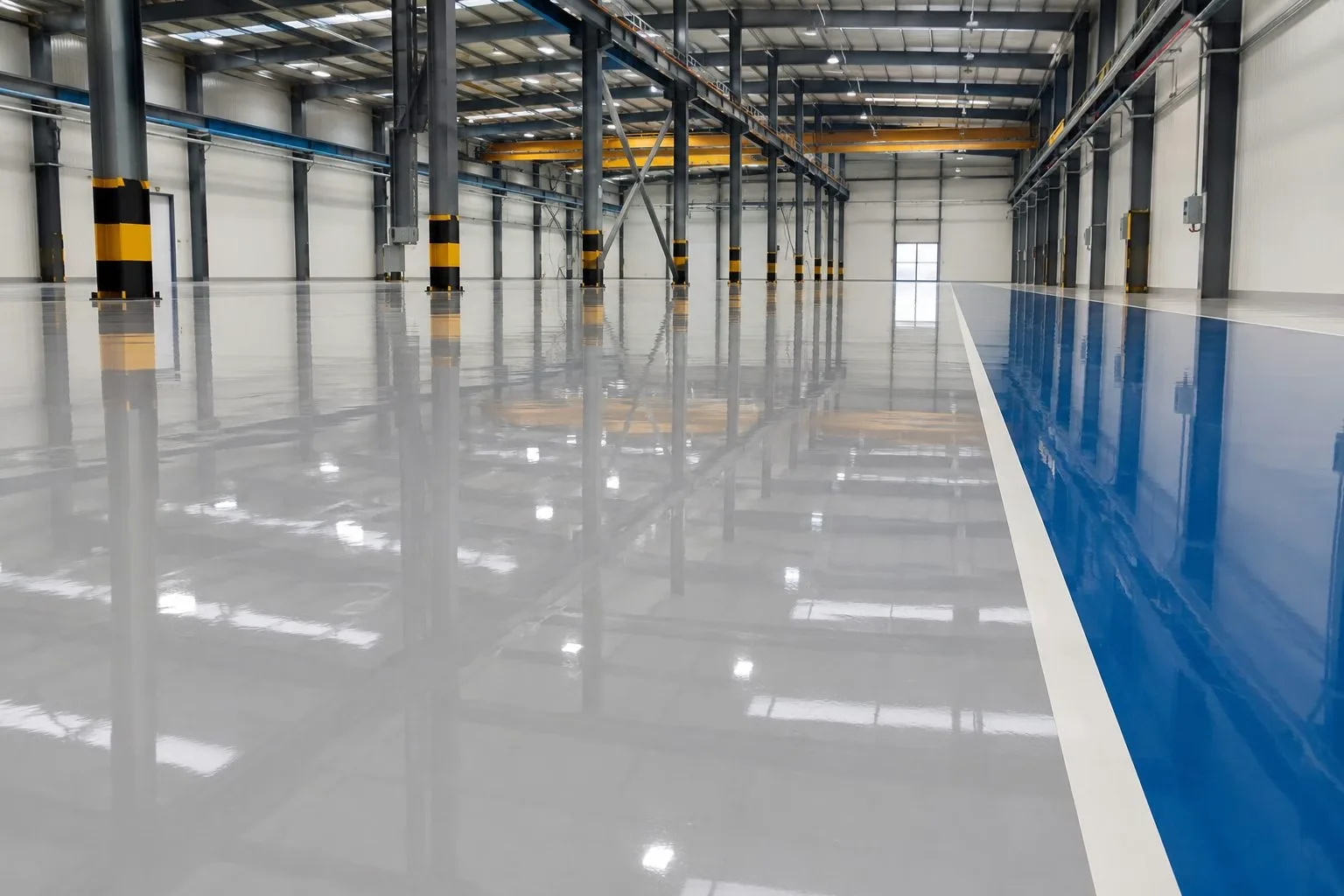
A polyurethane topcoat applied over an epoxy body coat improves the UV stability, flexibility and abrasion resistance of the floor. For floor systems in detail, see What Is a Polyurethane Floor Coating? and Polyurethane Top Coat: Properties and Correct Application Methods.
Machinery, Equipment and Vehicle Coatings
Agricultural machinery, construction equipment, rail vehicles and industrial equipment face both outdoor exposure and chemical contact. On these surfaces a two component polyurethane is the standard topcoat because it combines a durable finish with a lasting decorative appearance.
Wood, Furniture and Plastic Surfaces
Furniture and parquet lacquers are formulated as two component polyurethane systems to give wood surfaces abrasion and chemical resistance. Thanks to their flexibility they also adhere well to plastic parts without cracking.
Site Parameters That Decide the Result
With two component polyurethane coatings, application discipline often matters more than the material itself.
- Mixing ratio: components A and B are mixed in the ratio given by the manufacturer, preferably by weight. Excess hardener makes the film brittle, while too little leaves a soft, tacky surface,
- Pot life: it starts at the moment of mixing and shortens as temperature rises. Material that has started to thicken in the can must not be thinned and used,
- Relative humidity: isocyanate reacts with moisture and releases carbon dioxide. High humidity causes bubbles, pinholes and loss of gloss. As a general rule, apply below 80 percent relative humidity,
- Dew point: the substrate temperature must be at least 3 °C above the dew point. Otherwise an invisible film of moisture forms on the surface,
- Film thickness: wet film thickness is checked with a comb gauge during application. Applying too much in a single coat traps solvent and causes drying defects,
- Overcoating interval: follow the minimum and maximum intervals given by the manufacturer. Once the maximum is exceeded, the surface must be abraded before the next coat.
Preparing the coat underneath matters as much as the topcoat. For primer selection on concrete, see Epoxy Primer: What It Is and Why It Matters, and for suitable products our 2K Epoxy Primer page.
Safety and Diisocyanate Training Requirements
The hardener of a two component polyurethane coating contains isocyanate. Under the restriction in REACH Annex XVII, industrial and professional use of products with more than 0.1 percent free monomeric diisocyanate by weight has required training since 24 August 2023. For current training levels, refer to the official industry portal Safe Use of Diisocyanates.
Spray application requires suitable respiratory protection, chemical-resistant gloves and goggles, and adequate ventilation in enclosed spaces. An opened hardener pack becomes unusable once it absorbs moisture, so containers must be closed tightly after every use.
Common Mistakes
- Using an aromatic topcoat outdoors: the colour fades quickly and the surface starts to chalk,
- Mixing by eye: a ratio error disrupts curing and cannot be corrected later,
- Carrying on in humid weather: bubbles and loss of gloss remain as permanent defects,
- Thinning material past its pot life: film strength drops and adhesion weakens,
- Applying the topcoat over a poorly prepared base: even the best topcoat will not reach its expected service life on a weak primer.
Conclusion
Thanks to its abrasion and chemical resistance, its flexibility and, in aliphatic grades, its UV stability, a two component polyurethane coating is one of the core solutions for protecting industrial surfaces. The right system becomes clear from two questions: does the surface see sunlight, and which mechanical and chemical loads does it face? The answers decide between an aliphatic and an aromatic system and define the coat structure and film thickness.
On site, three things decide the outcome: the mixing ratio, humidity and dew point control, and keeping to the overcoating interval. For projects that need very fast curing, see Polyurea systems, and for our full construction chemicals range visit the PLUSKIM COAT Series page.
Contact our technical team to define the two component polyurethane system that fits your project.
Related Reading
Let us specify the right system for your line
Tell us your application, line type and target density; our technical team will reply with a formulation proposal.