TDI Polyurethane: Applications, Handling and Sourcing Guide
When a mattress keeps its shape for years, or a sofa stays soft yet supportive, much of the credit goes to the flexible polyurethane foam inside. Most of that foam is made with one raw material: TDI, toluene diisocyanate. In this guide we explain what TDI polyurethane is, how it differs from MDI, which products it is used in, the rules for safe handling and storage, and what to look for when choosing a supplier.
What Is TDI?
TDI is an aromatic diisocyanate carrying two isocyanate (NCO) groups. Polyurethane forms when isocyanates react with polyols, and TDI is one of the two main components of that reaction. At room temperature it is a colourless to pale yellow liquid with an NCO content of about 48 percent.
TDI has two isomers: 2,4-TDI and 2,6-TDI. Commercial grades are named after the ratio of the two. The most common grade is TDI 80/20, which contains 80 percent of the 2,4 isomer; other ratios such as TDI 65/35 are also available. Because the isomer ratio affects reaction speed and the cell structure of the foam, formulations are built around it.
How TDI Differs from MDI
TDI and MDI are the two most widely used isocyanates in the polyurethane industry. MDI is a larger molecule with a much lower vapour pressure than TDI. These two differences also shape where each is used:
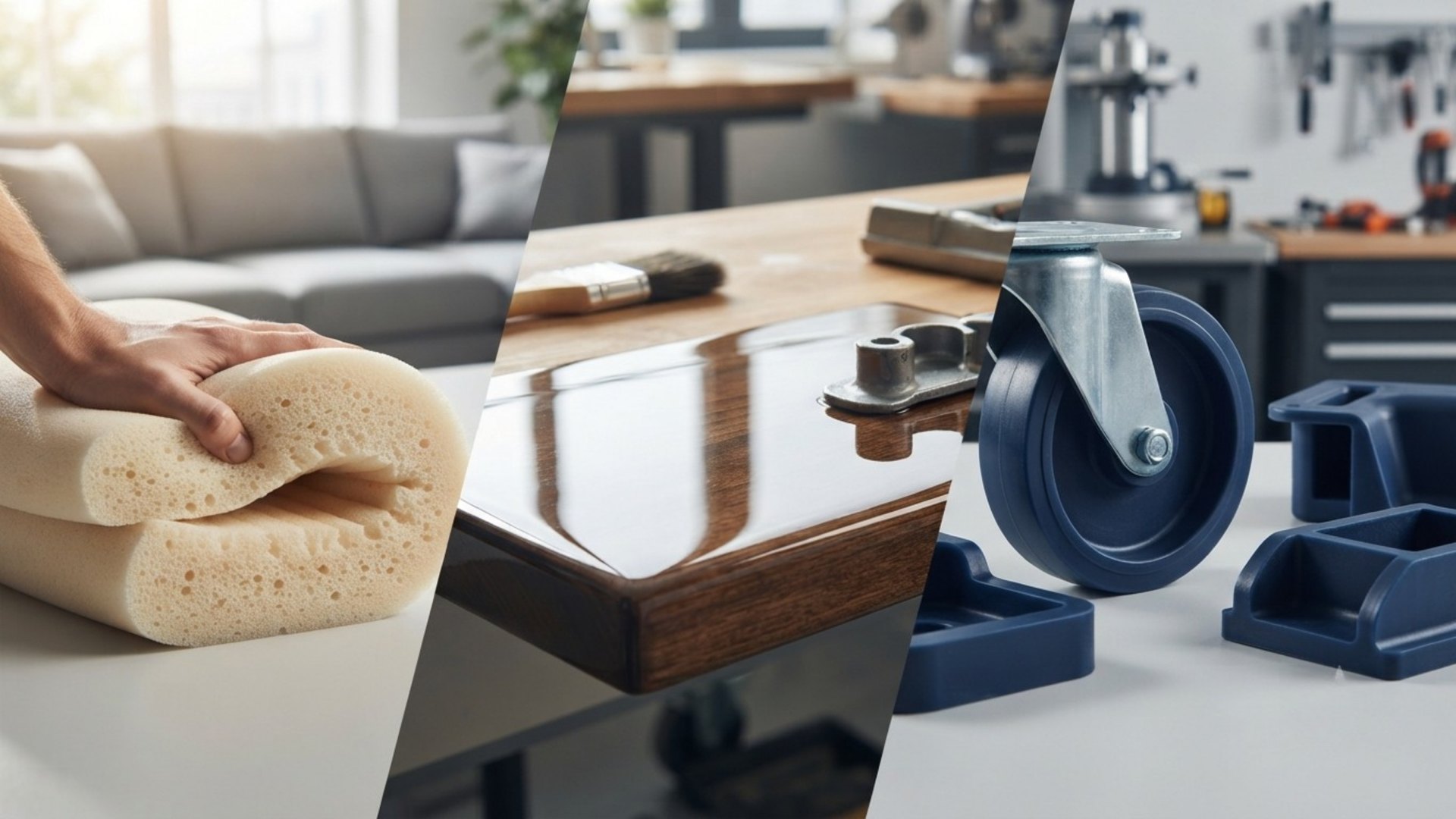
- TDI: used mainly in flexible slabstock (block) foam. Most mattress, sofa and upholstery foam is TDI-based,
- MDI: dominant in rigid foams such as sandwich panels, cold room panels, refrigerators and spray insulation, and widely used in moulded foam, elastomers and adhesives,
- Blends: some moulded foam systems combine TDI and MDI to balance processing with the properties of the finished part.
You can explore MDI-based systems on our polyol and MDI systems page, and the rigid foam side in our article on spray foam insulation chemicals.
Where TDI Polyurethane Is Used
Flexible Slabstock Foam
The largest use of TDI is slabstock foam produced on continuous lines. Polyether polyol, TDI, water, catalysts and a silicone surfactant meet in the mixing head; carbon dioxide released by the reaction of water with isocyanate expands the foam. Foam density and hardness are tuned through the water level and the isocyanate index. See our polyether polyols for the polyol side of these systems and our slabstock foam systems page.
Moulded Foam and Furniture
Moulded foams for car seats and furniture need high resilience and durability. These systems can use TDI, MDI or a blend of the two. For moulded and memory foam applications in furniture, see our HR moulded foam and viscoelastic memory foam pages.
Coatings, Adhesives and Elastomers
TDI is often used not directly but after conversion into an intermediate. TDI-based prepolymers and adducts act as hardeners in wood and furniture lacquers, in adhesives and in cast elastomers. Wheels, rollers and wear-resistant parts are made with this kind of elastomer system. We explain the role of prepolymers in polyurethane systems in our article on the use of prepolymers.
Safe Handling
Because TDI has a higher vapour pressure than MDI, it gives off vapour even at room temperature. Inhalation exposure is therefore the main risk when working with TDI. Under the EU classification, TDI is labelled as fatal if inhaled (H330) and as a respiratory sensitiser (H334). In a person who has become sensitised, even very low concentrations can trigger asthma-like reactions.
- Closed systems: transfer and metering are done through closed lines wherever possible, with no pouring from open containers,
- Ventilation: local exhaust at the work area plus adequate general ventilation,
- Personal protective equipment: suitable respiratory protection, chemical-resistant gloves, goggles and workwear,
- Spill plan: neutralising material and written instructions for spills are kept ready on site.
In the European Union, under the REACH Annex XVII restriction, industrial and professional use of products containing more than 0.1 percent free monomeric diisocyanate by weight has required training since 24 August 2023. Current training requirements should be checked on the official Safe Use of Diisocyanates portal. In every case, read the product's Safety Data Sheet before starting work.
Storage and Transport
TDI reacts with moisture, producing carbon dioxide and an insoluble urea sediment. In a closed container the carbon dioxide can build up pressure, while the sediment spoils product quality. TDI is therefore stored dry in tightly closed containers, and under dry nitrogen in tanks. Because it can crystallise at low temperatures, the storage temperature should be kept within the range given in the Technical Data Sheet and Safety Data Sheet.
For transport, TDI falls under dangerous goods regulations (UN 2078, class 6.1). Shipping, labelling and vehicle equipment must match this classification.
What to Look for When Sourcing TDI
Choosing TDI on price alone can lead to unpredictable problems on the production line. When evaluating a supplier, check the following:
- Certificate of analysis: isomer ratio, NCO content, acidity and colour should be documented for every batch. Acidity has a direct effect on reaction speed,
- Batch-to-batch consistency: on slabstock lines even small differences in reactivity turn into density and hardness deviations,
- Regulatory documents: check the Safety Data Sheet in your language and the registration status under REACH and, for Türkiye, KKDİK,
- Packaging and logistics: drum, IBC or bulk tanker options, lead time and stock security should fit your production plan,
- Technical support: a supplier who can support formulation and line settings shortens trials and reduces scrap.
We cover general raw material sourcing criteria in detail in our polyol supplier guide.
Common Mistakes
- Not resealing an opened container tightly: moisture gets in and creates sediment and pressure,
- Using TDI from cold storage without checking it: crystallised product upsets metering and mixing,
- Overlooking the isomer ratio: using a different grade instead of TDI 80/20 changes reactivity and cell structure,
- Relying on general fans alone: sources such as the mixing head and pour point need local exhaust,
- Not asking for a certificate of analysis: batch differences only show up once a production problem appears.
Conclusion
TDI is the core raw material of flexible polyurethane foam and also plays an important role in coatings, adhesives and elastomers. Using it well rests on two things: a product that is consistent in isomer ratio and analysis values, and a plant that works safely with closed systems, ventilation and protective equipment.
You can explore our MDI- and TDI-based isocyanates on our isocyanates (MDI and TDI) page. Contact our technical team to match the right isocyanate and polyol to your line and to request a sample.

Let us specify the right system for your line
Tell us your application, line type and target density; our technical team will reply with a formulation proposal.