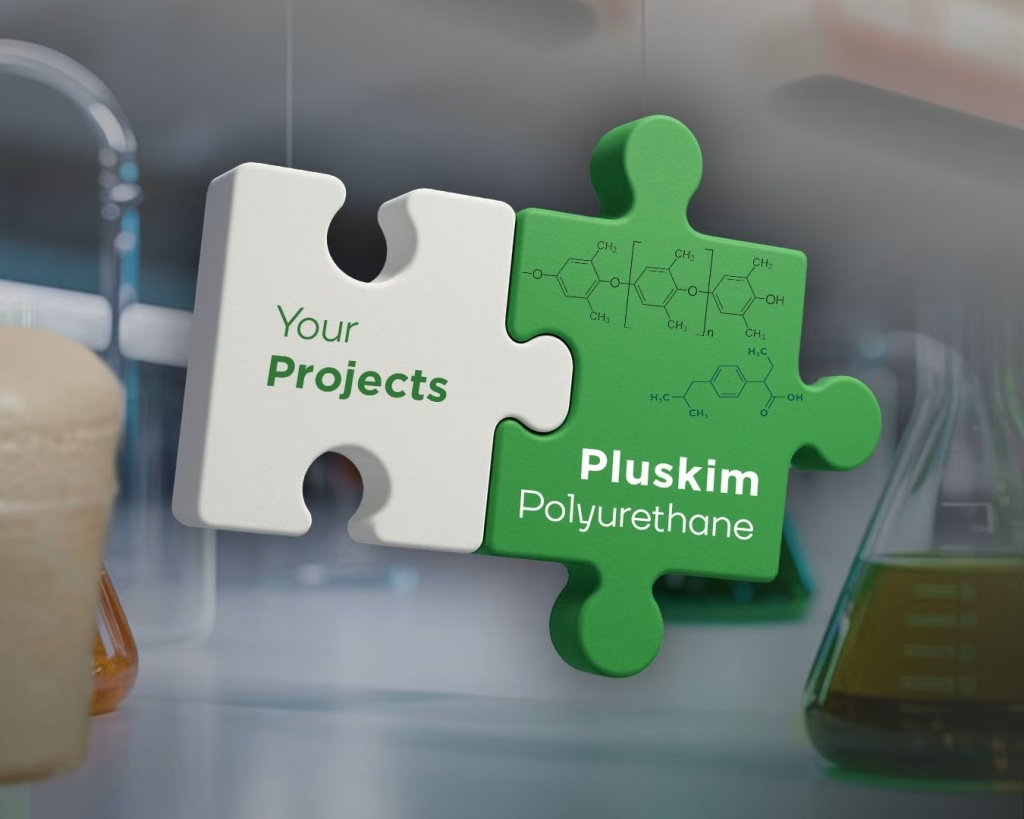
Prepolymer and polyester synthesis is one of the most critical processes determining the performance of polyurethane systems. Standard formulations are rarely sufficient for diverse industrial applications. Each sector requires technically optimized solutions tailored to specific processing and performance expectations.
Pluskim develops custom prepolymers and polyester polyols according to customer requirements, ensuring application-based optimization, improved production efficiency, and high-performance polyurethane systems.
👉 Explore our full range of Polyurethane Systems
What Is a Prepolymer?
A prepolymer is a semi-finished reactive component produced by the controlled reaction between isocyanates (MDI or TDI) and polyols.
Key advantages include:
-
Controlled reactivity
-
Adjustable NCO content
-
Optimized curing time
-
Enhanced mechanical performance
Prepolymers play a decisive role in casting, molding, coating, and industrial PU applications.
What Is a Polyester Polyol?
A polyester polyol is produced through the condensation reaction of acids and diols. It determines the final polyurethane system’s hardness, flexibility, chemical resistance, and durability.
Critical parameters include:
-
Hydroxyl value
-
Acid number
-
Molecular weight
-
Viscosity
Selecting the correct polyester polyol directly impacts long-term product performance.
Application-Specific Prepolymer and Polyester Development
Pluskim follows a project-based formulation strategy rather than offering standardized products.
Process-Oriented Optimization
-
Spray polyurethane systems
-
Casting and molding applications
-
Injection systems
-
Block production
-
Flexible, rigid, and semi-rigid PU systems
Each formulation is optimized for viscosity, reactivity, and curing profile based on processing requirements.
Technical Parameter Flexibility
Custom synthesis allows adjustment of:
-
NCO content
-
Hydroxyl value
-
Viscosity level
-
Acid number
-
Flame retardant additives
-
Rheology modifiers
-
Plasticizer integration
This flexibility ensures alignment with targeted mechanical and chemical performance benchmarks.
Laboratory and Pilot Production Support
Pluskim adopts an R&D-driven approach:
-
Custom sample production
-
Compatibility testing
-
Pilot-scale trials
-
Process optimization consultancy
Each formulation is validated through performance testing before industrial implementation.
Critical Parameters in the Synthesis Process
NCO Content
Determines reactivity and curing speed. Requires precise adjustment depending on application.
Viscosity
Ensures compatibility with spray, casting, or injection processes.
Hardness/Flexibility Balance
Optimized to achieve target mechanical properties.
Thermal Stability
Essential for high-temperature-resistant systems.
Chemical Resistance
Crucial for automotive, construction, and industrial environments.
Industry Applications
Construction Industry
Spray insulation systems, sandwich panel solutions
Automotive Sector
Seats, steering components, acoustic insulation
Furniture Industry
Flexible foams, decorative polyurethane components
Hygienic Products
Low-VOC prepolymer systems
Industrial Molding
Metal coating systems, technical PU castings
Why Custom Synthesis?
Standard formulations often fail to deliver optimal performance.
Custom prepolymer and polyester synthesis:
-
Maximizes product performance
-
Reduces production waste
-
Improves process efficiency
-
Provides long-term cost advantages
Pluskim approaches each request as an R&D project, designing every formulation to create measurable technical and commercial value.
Performance Optimization Through Molecular Design
In polyurethane chemistry, performance is not determined solely by raw material selection but by precise molecular architecture. Through controlled prepolymer and polyester polyol synthesis, Pluskim fine-tunes chain length, crosslink density, and functional group distribution to achieve targeted mechanical and chemical properties.
Adjusting molecular weight distribution and functionality enables:
-
Improved tensile strength and elongation balance
-
Enhanced abrasion resistance
-
Superior hydrolytic stability
-
Controlled gel time and demolding performance
For high-performance industrial systems, micro-level adjustments in NCO functionality and hydroxyl structure significantly influence final product behavior. This level of customization is particularly critical in applications requiring dimensional stability, long-term durability, and resistance to aggressive environments.
Quality Control and Process Consistency
Consistency is essential in polyurethane production. Each synthesized batch undergoes strict quality control procedures, including:
-
NCO titration analysis
-
Viscosity measurement under controlled temperature
-
Hydroxyl value verification
-
Thermal aging simulations
These analytical controls ensure reproducibility, minimize batch-to-batch variation, and guarantee process reliability in large-scale manufacturing environments.
By combining advanced synthesis capabilities with technical consultancy, Pluskim supports manufacturers in developing high-efficiency, performance-driven polyurethane solutions tailored to evolving industry demands.