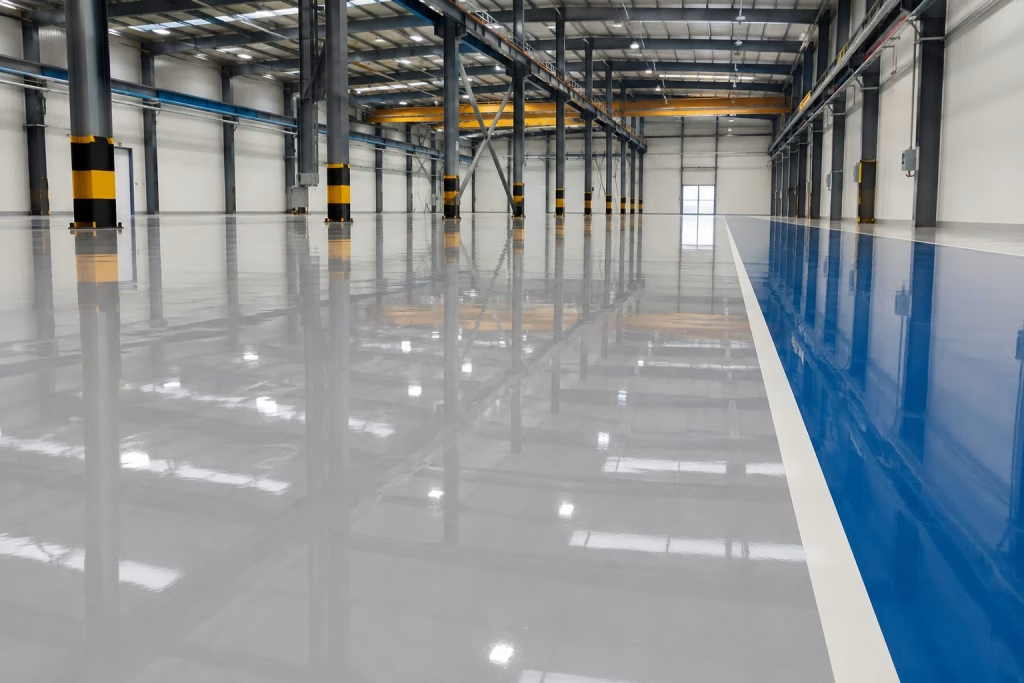
For years epoxy was treated as the only serious option for industrial floors. Yet on floors that move, vibrate, see daylight or are exposed to repeated thermal shock, a polyurethane floor coating stays intact exactly where a rigid epoxy film cracks. This article covers how a polyurethane floor coating differs from epoxy systems, its key properties such as flexibility and UV stability, where it belongs from food plants to car parks, the layer-by-layer application sequence, the safety obligations involved and the service life you can expect.
What Is a Polyurethane Floor Coating?
Concrete is strong in compression but porous. Left exposed, water, oil, acid and mechanical wear work their way into it; dusting begins and reinforcement becomes vulnerable to corrosion. Resin based floor systems are applied to seal that surface and isolate the concrete from chemical and mechanical attack.
A polyurethane floor coating is a two component (2K) system in which polyol and isocyanate components are mixed on site at a defined ratio, react, and cure in place to form a seamless film. The cured film behaves elastomerically compared with epoxy: it stretches to a degree and tends to return to its original dimension.
That difference in behaviour comes straight from the chemistry. Epoxy resins form a densely cross-linked, hard and relatively brittle network. Polyurethane chains contain “soft segments”, and it is these that give the material flexibility and the ability to absorb impact. The balance between hardness and flexibility is tuned through the polyol type in the formulation.
In Europe, product properties for the protection and repair of concrete surfaces are defined under EN 1504-2, while resin based floor coatings and screeds fall under EN 13813. For the institutional framework in which these standards are prepared, the resources of CEN-CENELEC can be consulted.
Polyurethane Floor Coating Compared With Epoxy
Both systems protect concrete, but they come into their own under different conditions. The choice is not settled by asking which is better; it is settled by asking what the floor actually does.
Flexibility and Crack Bridging
Elongation at break for an epoxy film is typically in the 2-5 percent range. It is hard and durable but it does not follow movement. In polyurethane systems that figure can exceed 50 percent, and in elastomeric grades 300 percent, depending on formulation.
In practice this means a hairline crack that develops in the slab is mirrored straight through an epoxy coating. A flexible system bridges the crack and film integrity is preserved. Where joints move, machine plinths vibrate or differential settlement is expected, this is the deciding criterion.
UV Stability and Colour Change
Epoxies yellow under ultraviolet light and chalk at the surface. The deterioration is primarily visual, but over time it also degrades surface quality. Aliphatic polyurethanes have high UV stability and are therefore preferred on floors open to the air or in spaces with abundant daylight.
A common and economical solution is to build the body in epoxy and close it with an aliphatic polyurethane. 2K Aliphatic PU Top Coat is an example of the topcoat class used for this purpose. For the reasoning behind topcoats in detail, see our article Polyurethane Top Coat.
Thermal Shock and Temperature Resistance
In food plants the floor is washed down with hot water or steam. That creates an abrupt expansion and contraction cycle at the surface. A hard, rigid film that cannot absorb the difference in expansion between itself and the slab loses adhesion and blisters.
Polyurethane based systems, and polyurethane-cement mortars in particular, tolerate that cycle markedly better. In production areas subject to steam cleaning the decision usually settles in this direction.
Chemical Resistance
Epoxy performs strongly against acids and many solvents. Polyurethane generally gives better results against organic acids, oils, food-derived agents such as lactic and citric acid, and in alkaline environments. The correct choice is made by comparing what is actually spilled on the floor against the chemical resistance table; the phrase “general purpose” is not a criterion on its own.
Abrasion, Impact and Slip Resistance
In areas with forklift traffic, abrasion and impact must be assessed together. A hard surface resists abrasion well but can fracture locally when a heavy part is dropped on it. A flexible film absorbs the impact. Slip resistance is a separate heading, set by the aggregate broadcast into the topcoat; in wet areas that decision belongs in the design stage, not afterwards.
In summary:
- Moving floors with a risk of cracking: polyurethane stands out,
- Floors in daylight or open to the exterior: an aliphatic polyurethane topcoat is required,
- Production areas washed with hot water and steam: a polyurethane based system is advantageous,
- Enclosed areas with heavy acid contact: an epoxy body is sufficient in most cases,
- High surface hardness with cost as the priority: an epoxy system gives the cost advantage.
For the epoxy side of the comparison, our articles Epoxy Floor Coating Guide and Industrial Epoxy Coating complete the picture.
Where a Polyurethane Floor Coating Is Used
Food and Beverage Production
In dairy, meat, ready meal and beverage production the floor is permanently wet, exposed to organic acids and washed with hot water. Hygiene requires a non-porous, seamless surface and coved skirting at wall junctions rather than a conventional skirting board. Polyurethane systems are widespread in this sector precisely because they can satisfy all three conditions at once.
Pharmaceutical Manufacturing and Cleanrooms
The non-dusting, easily decontaminated surface that cleanroom classification demands is delivered by seamless resin coatings. The disinfectant in use must appear in the chemical resistance table, and the electrostatic behaviour of the surface (conductive or antistatic requirement) must be defined from the outset.
Car Parks, Ramps and Exposed Decks
Car park floors see three effects at once: vehicle traffic, de-icing salt and water ingress, and UV on exposed upper decks. Because of structural joints and thermal movement in the slab, crack bridging is a genuine requirement here. On ramp sections slip resistance is addressed separately.
Cold Stores and Blast Freezing Areas
Rigid resins become brittle at low temperature. In spaces subject to abrupt temperature change, such as blast chillers, systems that behave flexibly are safer. Application temperature and cure time must also be planned for these areas, since low temperature slows the reaction.
System Layers and Application Steps
Most site failures originate not in the material but in skipping the logic of the layers. A typical polyurethane floor coating system consists of four layers.
- Substrate preparation: Laitance, remnants of old coatings and oil contamination are removed mechanically. The preferred methods are shot blasting or grinding; sweeping or washing does not count as preparation. After preparation the pull-off strength of the surface is generally expected to be at least 1.5 N/mm²,
- Primer: Fills the pores, establishes adhesion and prevents air rising out of the concrete from forming pinholes in the layer above. On damp or recently poured concrete a moisture tolerant primer is used. For detail see Epoxy Primer Explained and the 2K Epoxy Primer product page,
- Body layer: This carries the thickness and the mechanical performance of the system. Self-levelling applications are typically 2-4 mm, while heavy duty mortar systems run to 6-9 mm. Expected traffic and impact load determine the choice,
- Topcoat: The final layer that sets colour, gloss, chemical resistance and slip resistance. Aliphatic polyurethane is preferred on floors exposed to the elements; where slip resistance is required, aggregate is broadcast at this stage.
Overcoating times between layers must be observed. A layer applied too early disturbs the reaction beneath it, while one applied too late misses the chemical adhesion window and will not bond without abrading the surface first.
Parameters That Decide the Outcome on Site
- Mixing ratio: Components A and B are weighed and mixed at the ratio given by the manufacturer. Dosing by eye disrupts the cure and the surface can remain permanently tacky,
- Mixing discipline: A low speed mixer is used to achieve a homogeneous blend including the base and sides of the container; decanting the mixed material into a clean vessel and briefly re-mixing eliminates the risk of unmixed component left at the bottom,
- Pot life: Begins at the moment of mixing and shortens as temperature rises. A figure quoted for 20 °C falls appreciably at 30 °C, and the site programme must reflect that,
- Concrete moisture: The general acceptance level is below 4 percent by weight using the CM method. High moisture is the most frequent cause of blistering and adhesion loss,
- Dew point: Surface temperature must be at least 3 °C above the ambient dew point. Otherwise an invisible film of moisture forms on the surface and the isocyanate reacts with it, causing foaming,
- Ambient temperature: Low temperature slows the cure and raises viscosity; high temperature shortens pot life and makes levelling harder.
Safety and the Diisocyanate Training Obligation
The B component of polyurethane systems contains isocyanate. Under the restriction in REACH Annex XVII in the European Union, industrial and professional use of products containing more than 0.1 percent by weight of free monomeric diisocyanate has been subject to a training requirement since 24 August 2023. The industry training portal Safe Use of Diisocyanates should be taken as the basis for the current scope and training levels.
The fundamental site rules do not change: appropriate respiratory protection, chemically resistant gloves and eye protection, mandatory ventilation in enclosed spaces, and packaging kept closed and away from moisture. Once an opened container of isocyanate component takes up moisture it becomes unusable.
Maintenance and Expected Service Life
Service life depends less on the material than on intensity of use and maintenance. Light traffic areas can deliver more than ten years of performance, while in dispatch aisles under constant forklift traffic earlier renewal of the topcoat is normal.
Three headings govern maintenance:
- Correct cleaning: Aggressive solvents and wire brushes dull the surface; neutral or mildly alkaline cleaners recommended by the manufacturer should be used,
- Early repair: A local scratch or delamination repaired before it spreads needs only a patch. Left too long, water reaches the concrete surface and the scope of repair widens,
- Periodic inspection: Once a year, joint surrounds, doorways, ramp transitions and machine plinths should be checked; wear always starts at these transition points.
Renewing the topcoat on time is the single most effective maintenance item for total cost, because it protects the body layer underneath.
Common Mistakes in Selection and Application
- Economising on substrate preparation: The source of most adhesion failures; the time saved by skipping blasting is lost many times over when stripping a blistered floor,
- Starting without a moisture reading: Concrete can look dry; the decision is not made without measuring,
- Using an aromatic topcoat on an exposed floor: Colour fades quickly and the surface begins to chalk,
- Selecting thickness by budget rather than traffic: A system applied thin wears out early under forklift traffic,
- Leaving slip resistance out of the design: Solving it afterwards in a wet area means recoating the surface,
- Judging chemical resistance on a single agent: Every substance that reaches the floor should be checked against the table.
Conclusion
A polyurethane floor coating offers a dependable solution wherever epoxy struggles, thanks to its flexibility, crack bridging capability, UV stability and resistance to thermal shock. The right choice becomes clear with three questions: does the floor move, does it see sunlight, and how is it cleaned? Once those are answered, system thickness, topcoat type and slip resistance follow as straightforward technical decisions.
On the application side three things determine the result: substrate preparation, control of moisture and dew point, and respecting the overcoating windows between layers. However good the material, skipping these three means the system will not deliver its expected life.
For where fast-curing alternatives such as polyurea come into their own, see Polyurea – The New Benchmark in High-Performance Industrial Coatings, and for our full construction chemicals range see the Pluskim Coat Series page.
Contact our technical team to determine together the system best suited to the floor conditions in your facility.