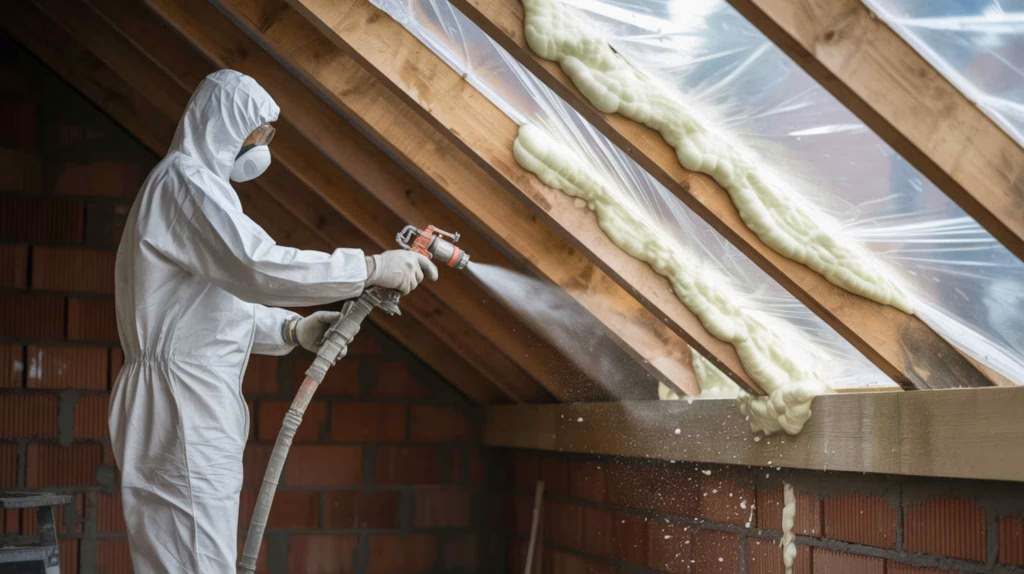
Polyurethane systems are high-performance materials widely used in construction, automotive, insulation, flooring, and industrial manufacturing applications. However, application mistakes in polyurethane systems can significantly reduce product performance and lead to costly long-term issues.
In this article, we examine the 7 most common application mistakes in polyurethane systems, their technical consequences, and why selecting the right system is critical.
1. Incorrect Mixing Ratio (A/B Imbalance)
Polyurethane systems are formed through a controlled chemical reaction between isocyanate (Component A) and polyol (Component B). Therefore, the A/B mixing ratio is one of the most critical parameters directly affecting system performance.
When an incorrect mixing ratio is used, the following issues may occur in polyurethane systems:
-
Low mechanical strength
-
Insufficient or irregular adhesion
-
Incomplete, delayed, or failed curing
-
Surface brittleness, oiliness, or tackiness
Especially when automatic dosing systems are not properly calibrated, polyurethane results achieved in laboratory conditions cannot be replicated on site.
2. Inappropriate Ambient Temperature and Humidity
In polyurethane systems, reaction speed and final product quality are directly affected by ambient temperature and relative humidity. While low temperatures slow down the reaction, high humidity can react with isocyanates, causing deterioration in foam structure.
This can lead to:
-
Irregular cell structure
-
Density variations
-
Weak mechanical properties
-
Surface defects and porosity
A significant portion of application errors in polyurethane systems results from field conditions that do not match laboratory environments.
3. Inadequate Surface Preparation
Proper surface preparation is essential for polyurethane systems to achieve maximum adhesion performance. Dusty, oily, damp, or weak substrates cause serious adhesion problems in polyurethane applications.
Common issues caused by insufficient surface preparation include:
-
Delamination
-
Layer separation over time
-
Loss of mechanical strength
-
Reduced service life of the application
Therefore, surface cleaning, roughening, and, when necessary, the use of appropriate primers must be an integral part of the process.
4. Incorrect Viscosity Selection
Each polyurethane system is designed within specific viscosity ranges depending on the application method. Selecting the wrong viscosity for spray, casting, injection, or molding applications directly affects application quality.
In polyurethane systems with incorrect viscosity:
-
Uniform surface spreading cannot be achieved
-
Voids and air entrapment occur
-
Final product quality decreases
For this reason, polyurethane system selection should consider not only chemical composition but also viscosity compatibility with the application method.
5. Reactivity Time Not Compatible with the Process
In polyurethane systems, gel time and curing speed must be compatible with production line speed. Systems with very short reactivity times make application control difficult, while overly long reactivity times reduce production efficiency.
This mismatch may result in:
-
Faulty applications
-
Production downtime
-
Increased scrap rates
Reactivity adjustment in polyurethane systems is critical not only for performance but also for process continuity.
6. Incorrect or Excessive Use of Additives
Flame retardants, plasticizers, fillers, and rheology modifiers are used in polyurethane systems for specific purposes. However, uncontrolled or excessive use of additives disrupts system balance.
Incorrect additive usage may cause:
-
Deterioration of cell structure
-
Reduced mechanical properties
-
Long-term performance loss
Therefore, additive usage must be integrated into system design and applied in a controlled manner.
7. Use of Polyurethane Systems Not Designed for the Specific Application
A standard polyurethane system should not be expected to deliver the same performance across all applications. As production conditions, environmental factors, and target performance requirements change, polyurethane system design must be adapted accordingly.
Polyurethane systems not tailored to the application may:
-
Fail to meet performance expectations
-
Require constant adjustments
-
Increase production costs
The Pluskim Approach
Pluskim evaluates polyurethane systems not only based on technical data sheets but also according to the customer’s actual production conditions, process structure, and target performance criteria.
Within the Pluskim approach, every polyurethane system is treated as a dedicated R&D process. The goal is to achieve sustainable production performance and long-lasting application results rather than short-term solutions.
📩 For application-specific polyurethane system solutions:
👉 www.pluskim.com