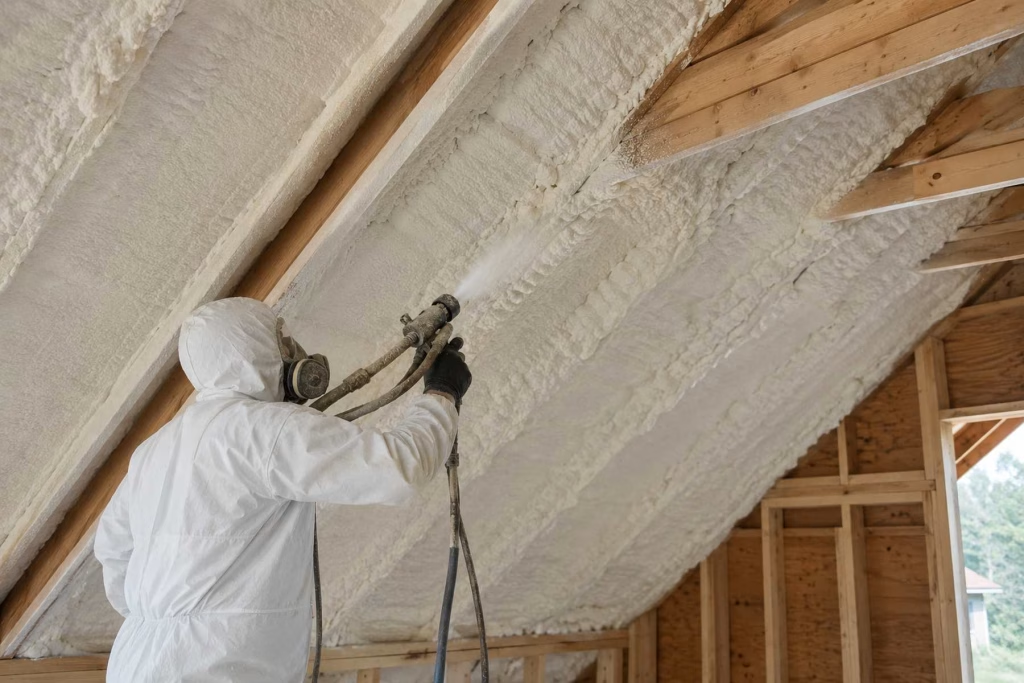
As energy costs continue to rise, minimizing heat loss in buildings has become a critical issue for both household budgets and the broader economy. Heating and cooling expenses make up a large share of residential energy consumption, which makes choosing the right insulation material less of an option and more of a necessity. This is where polyurethane spray foam systems stand out, offering performance that outpaces traditional insulation methods.
Why Does Heat Loss Matter So Much?
Most of the heat lost in a building comes from gaps in the roof, exterior walls, and flooring — as well as joint seams and insufficient insulation thickness. When conventional insulation boards are installed, the millimeter-scale gaps between panels gradually lead to air leakage, moisture buildup, and energy loss. Spray foam, on the other hand, expands within seconds of application, seamlessly covering every crack, corner, and irregular surface. This gives a building’s “airtightness” a level far beyond what classic methods can achieve.
How Does Polyurethane Spray Foam Work?
Polyurethane spray foam is created when a polyol blend and polymeric MDI component are sprayed onto a surface under high pressure. The moment these two components combine, a chemical reaction begins, and the mixture expands within seconds into a cellular structure. This structure functions as both an effective thermal insulation layer and a barrier against water and air. Depending on the application and requirements, closed-cell or open-cell systems can be chosen; closed-cell systems offer higher density and water resistance, while open-cell systems have the edge in sound insulation and applications requiring flexibility.
Tangible Contributions to Energy Efficiency
1. High R-value: The thermal resistance (R-value) that polyurethane spray foam provides per unit thickness is considerably higher than traditional materials like fiberglass or mineral wool. This means the same insulation performance can often be achieved with a thinner application.
2. A seamless air barrier: Because spray foam is applied by spraying rather than laying down panels, it leaves no seams or joint gaps on the surface. This allows HVAC and heating systems to run less while maintaining the same comfort level.
3. Moisture control: In suitable formulations, spray foam also acts as a moisture barrier. This reduces moisture-related thermal bridging and mold risk, which positively affects both energy efficiency and the building’s lifespan.
4. Long-term performance stability: Properly applied spray foam systems don’t compress, sag, or develop gaps over time. This means insulation performance doesn’t degrade over the years — largely eliminating the “gradual efficiency loss” problem common with traditional materials.
Where Is It Used in Construction?
- Roofs and attics: One of the areas where heat loss is most significant, roofs benefit from spray foam’s ability to fully cover irregular beam gaps without issue.
- Exterior facades and wall cavities: Can be applied via injection or spraying, particularly in cavity wall systems.
- Floors and foundations: Closed-cell systems are preferred for floor applications requiring moisture resistance.
- Industrial facilities and cold storage: In facilities that need to maintain a constant temperature, spray foam is a critical investment that directly impacts energy costs.
Comparison with Traditional Insulation Methods
Fiberglass, mineral wool, and XPS/EPS boards are well-known solutions that are easy to install, but their biggest drawback is the joint gaps that form during installation and the performance loss that occurs as the material settles over time. Polyurethane spray foam, by forming a single, seamless insulation layer, largely eliminates these issues. Additionally, its short application time speeds up construction processes, saving on labor costs as well.
Why Choosing the Right System Matters
Every construction project has different needs. For a roof application, the priority might be waterproofing, while for an office building, the priority could be achieving both sound and thermal insulation together. That’s why technical parameters like density, cell structure, and application thickness in polyurethane spray foam systems need to be determined specifically for each project. Choosing the wrong system can mean failing to achieve the expected energy savings, as well as incurring unnecessary costs.
This is where working with an expert supplier becomes essential in determining the right formulation for a project’s specific needs. For detailed technical information on Pluskim’s polyurethane spray foam solutions, visit the Polyurethane Spray Foam page, where you can also get in touch with the technical team for a system suited to your project.
Conclusion
Energy efficiency is no longer just a cost item — it’s one of the core components of sustainable construction. With its high thermal resistance, seamless air barrier properties, and long-lasting performance, polyurethane spray foam stands out as one of the most effective ways to reduce energy expenses in both residential and industrial projects. With the right system selection and professional application, this technology becomes an investment that pays for itself over the years.