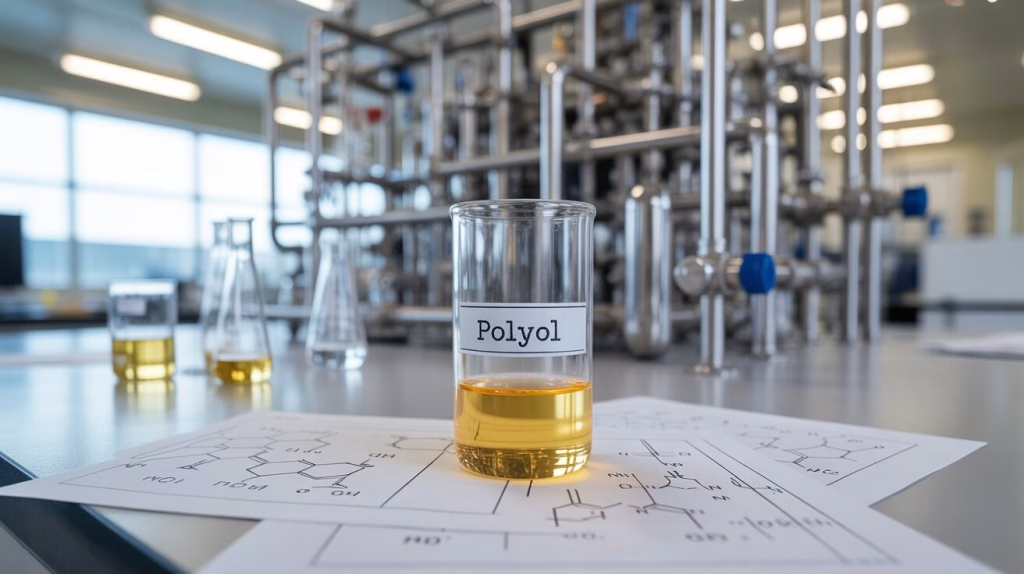
Thanks to its versatility, Polyurethane (PU) is used in a wide range of industries, from furniture to automotive and from construction to footwear. However, this versatility brings a complex decision-making process. While standard systems adopt a “one-size-fits-all” approach, application-specific systems take every detail into account—from the manufacturer’s machinery to the humidity levels of their geographical location.
1. Advantages and Applications of Standard Polyurethane Products
Standard polyurethane systems are products with pre-determined formulations and fixed performance based on generally accepted parameters.
-
Fast Supply and Logistical Ease: Standard products are usually available in stock, minimizing lead times for urgent production needs.
-
Predictable Cost Management: Unit prices are clear, allowing for a faster budgeting process.
-
Ease of Application: These systems are designed to work with standard machine settings, meaning operators do not need to make extreme adjustments.
-
Low-Variation Production: If your product does not require high technical precision or if your production environment (temperature, humidity) is fully controlled, standard products are the most rational solution.
2. Limitations of Standard Products: The “Hidden” Costs
Although standard products may appear economical at first, they can lead to production inefficiencies in certain scenarios.
-
Environmental Sensitivity: The polyurethane reaction is extremely sensitive to ambient temperature and humidity. A standard product may react too slowly in winter and expand uncontrollably in summer, which increases scrap rates.
-
Performance Compromises: A standard system may not perfectly meet the exact hardness or flexibility required for the final product. Settling for “good enough” can cause you to fall behind in highly competitive markets.
3. The Power of Custom-Tailored Polyurethane Systems
Polyurethane systems developed specifically for an application (tailor-made) are essentially a “work of engineering art.” R&D-focused companies like Pluskim rewrite the formulation from scratch by analyzing the customer’s production line as if it were a laboratory.
Technical Customization Parameters
When developing a custom system, the following variables are optimized:
-
Reaction Profile: Perfect alignment of cream time, gel time, and tack-free time with your production line speed.
-
Density: Reducing the weight of the product to save on raw materials without compromising mechanical properties.
-
Flowability: The ability to fill even the most intricate points of complex molds without errors.
-
Dimensional Stability: Ensuring the product does not shrink or expand after being removed from the mold.
4. Industry-Specific Examples of Custom Systems
To understand why custom systems are necessary, let’s look at specific sectors:
-
Footwear Industry: You cannot produce summer slippers and winter boots with the same system. Summer requires higher air transfer, while winter demands higher hydrolysis resistance and flexibility.
-
Insulation and Panel Production: In continuous production lines, the line speed and the rising speed of the polyurethane must be in millisecond-level harmony. Otherwise, gaps or structural defects occur in the panel.
-
Automotive (NVH Solutions): Custom PU foams developed for noise, vibration, and harshness (NVH) insulation are not just filler materials; they are critical engineering components that determine vehicle driving comfort.
5. Cost and Time Perspective: Initial Investment vs. Long-Term Profit
Many manufacturers hesitate, thinking that “the development cost of custom systems will be high.” However, the reality is quite the opposite.
| Parameter | Standard Product | Custom-Tailored System |
| Unit Raw Material Price | Lower | Slightly Higher |
| Scrap Rate | 5% – 10% | 1% – 2% |
| Cycle Time | Fixed | 15-20% Faster |
| Energy Consumption | Standard | Optimized |
| Total Production Cost | Medium/High | Lowest |
Even if a custom formulation shortens the de-molding time by just 10 seconds, in a factory producing thousands of units daily, this results in a significant increase in capacity and a decrease in unit energy costs.
6. How to Make the Right Decision? An Analytical Approach
Ask yourself these questions during the decision-making stage:
-
What is my production volume? In high-volume production, even a 1% improvement leads to massive annual profits.
-
Is my production environment stable? Are you affected by seasonal temperature changes?
-
Do my customers have specific expectations? (e.g., B1/B2 fire ratings, high abrasion resistance, etc.)
-
What is my current scrap rate? If you have high waste with a standard product, your formulation is likely incorrect.
The Pluskim Approach: We Offer Engineering, Not Just Raw Materials
At Pluskim, we don’t see polyurethane as just a chemical filled into drums. For us, every polyurethane system is a key that solves a problem on our customer’s production line.
Advantages of working with Pluskim:
-
Field Analysis: Our technical team inspects your production line on-site and analyzes your machine parameters.
-
Flexible R&D: In our laboratory, we establish the most optimized balance of “polyol and isocyanate” for you.
-
Sustainability: We help you reduce your environmental footprint by achieving higher performance with lower density.
-
Continuous Support: We provide technical support not just at the time of sale, but at every stage of the production process.
Conclusion
While standard polyurethane systems may seem like a safe harbor, “application-specific systems” are the true source of competitive advantage for manufacturers seeking efficiency and innovation. Choosing the wrong raw material creates hidden costs and time losses. The right system enhances both your product quality and your operational profitability.
Are you ready for an efficiency revolution in your production?
To determine the right system for your application, request a technical analysis, or discuss custom formulation needs, contact our expert team.
📩 For technical support and partnership: www.pluskim.com