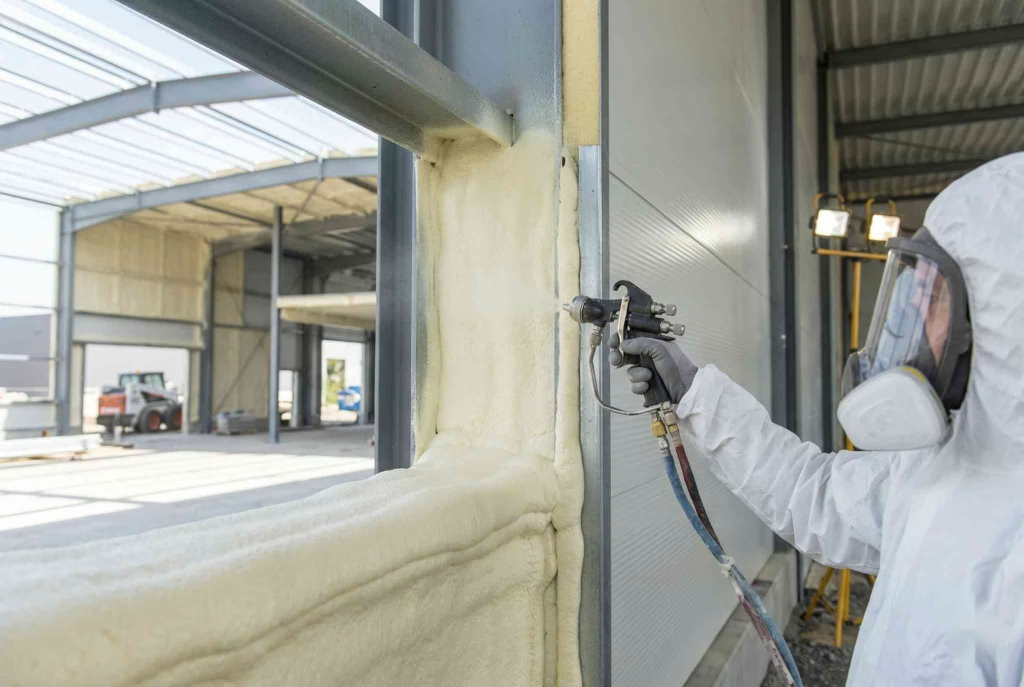
In today’s competitive commercial landscape, a primary priority for enterprises and contracting firms is to maximise build quality and energy efficiency whilst driving down operational costs. Volatility in energy prices and stringent sustainability targets have made the adoption of innovative insulation solutions an absolute necessity for industrial and commercial buildings. At this juncture, spray polyurethane foam (SPF) technology—which far surpasses the limitations of traditional insulation materials—has become the gold standard for B2B projects.
Whether you are constructing a vast logistics depot or upgrading the energy infrastructure of a manufacturing facility, specifying the right insulation directly impacts the long-term profitability of the project. In this comprehensive guide, we will delve into the technicalities of polyurethane foam technology, explore its variants, and outline why it constitutes the most lucrative investment for your business.
What is Spray Polyurethane Foam and Why is it the Industry Preference?
Spray polyurethane foam (SPF) is a cellular insulation material formulated by mixing two primary chemical constituents—isocyanate and polyol—under specific heat and pressure within specialised machinery. The moment it is sprayed onto a substrate, it reacts and expands to dozens of times its original volume within seconds, creating a continuous, seamless insulation layer.
The paramount reason for specifying polyurethane spray foam in industrial projects and large-scale commercial builds is its ability to entirely eradicate “thermal bridging”. With rigid board insulation such as mineral wool or fibreglass, air and heat leakage through the joints between panels remains the primary culprit for energy loss. Conversely, polyurethane in its spray form permeates even the most complex architectural detailing, pipe penetrations, and hard-to-reach junctions flawlessly, effectively enveloping the structure in a second skin.
What are the Variants of Polyurethane Spray Foam?
Insulation requirements in commercial projects vary considerably from one structure to the next. Consequently, specifying the correct material is of vital importance. The industry recognises two primary categories based on density and cellular structure: open-cell polyurethane foam and closed-cell polyurethane foam.
Open-Cell Polyurethane Foam: Flexibility and Acoustic Performance
Open-cell polyurethane foam, as the nomenclature suggests, is an insulation type where the minute cells within are not entirely enclosed, resulting in a more sponge-like and pliable structure. Upon application, it achieves an exceptionally high expansion rate (sometimes up to 100 times its original volume).
-
B2B Advantages: Due to its lower density, the open-cell structure is generally more cost-effective in terms of material expenditure. Thanks to its expansive properties, it rapidly fills internal wall cavities, loft spaces, and expansive ceiling panels.
-
Acoustic Insulation: Its capacity for sound absorption is remarkably high. This characteristic makes it indispensable for office blocks, conference facilities, hospitals, and internal commercial projects where acoustic performance is critical.
-
To achieve the optimal balance of acoustic and thermal performance in your interior projects, you can explore our high-performance Interior Insulation Solutions category to discover the ideal products for your specifications.
Closed-Cell Polyurethane Foam: Maximum Density and Thermal Resistance
Closed-cell polyurethane foam, on the other hand, is an exceptionally dense, rigid, and robust material where the cells are entirely sealed, trapping a specialised insulating gas within. This structural integrity completely prevents the ingress of water and moisture whilst delivering one of the highest R-values (thermal resistance coefficients) available on the market.
-
B2B Advantages: It is the definitive choice where industrial-grade durability is required. Owing to its high density, it enhances the structural integrity and racking strength of the applied surface. It fortifies the building against wind loads and vibration.
-
Water and Vapour Barrier: It negates the requirement for a supplementary vapour control layer. It delivers flawless performance in damp environments, external facades, foundation retaining walls, and industrial roofing subject to heavy water exposure.
-
Designed to shield the external envelope of your factories or warehouses against severe weather conditions, our External Facade and Roof Insulation Systems product portfolio represents one of the most efficient applications of closed-cell technology.
Applications of Spray Polyurethane Foam in B2B Projects
For commercial and industrial contractors, the sheer versatility of the insulation material streamlines both the supply chain and site management. The primary deployment scenarios for spray polyurethane foam within the commercial sector are as follows:
1. Commercial Roof and Terrace Insulation
Flat roofs represent the areas where industrial facilities suffer the greatest energy loss and carry the highest risk of water ingress. Traditional membrane systems eventually degrade and crack under the influence of UV radiation and thermal cycling. Closed-cell polyurethane foam, applied with a UV-protective topcoat, encapsulates the roof like a monolithic shield, resolving both waterproofing and thermal insulation requirements in a single, seamless application.
2. Cold Storage and Logistics Facilities
Temperature control is absolutely critical in the food, pharmaceutical, and chemical sectors. Even the slightest thermal leak in a cold store forces compressors to run continuously, leading to astronomical electricity bills and potential product spoilage. Closed-cell systems effectively lock in the chilled air whilst rigorously blocking the ingress of warm, moisture-laden external air.
3. Agricultural and Livestock Facilities
In environments such as poultry farms, cattle sheds, and mushroom cultivation plants, the internal climate directly dictates yield. Spray polyurethane foam can be rapidly applied to the ceilings and walls of these facilities, safeguarding livestock or produce from extreme temperature fluctuations. Furthermore, it resolves condensation issues, thereby mitigating the corrosion of metal roofing.
Cost and Efficiency Benefits of Polyurethane Spray Foam for Your Business
When making capital investment decisions on large-scale projects, the focus must shift from the raw material price to the Total Cost of Ownership (TCO) and Return on Investment (ROI).
Energy Savings and Rapid ROI
A high-calibre polyurethane insulation system can reduce the heating and cooling overheads of commercial buildings by 40% to 60%. Factoring in the monthly energy expenditure of an industrial plant, the capital outlay for the insulation typically pays for itself within a remarkably short period of 3 to 5 years. Additionally, as the building’s thermal load is reduced, further capital savings can be realised by specifying lower-capacity HVAC (Heating, Ventilation, and Air Conditioning) plant equipment.
Speed of Application and Reductions in Labour Costs
In B2B projects, time is unequivocally money. Cutting, transporting, mechanically fixing, and taping the joints of rigid board materials can consume weeks. Conversely, specialist teams equipped with mobile spray rigs can seamlessly cover hundreds of square metres per day. This significantly slashes on-site labour costs whilst facilitating an earlier practical completion of the project.
Longevity and Maintenance Overheads
Once cured, polyurethane spray foam does not slump, sag, or degrade in volume. It provides neither a food source nor nesting habitat for rodents, insects, or bacteria. Its performance lifespan is effectively congruent with that of the building itself. This reality relieves facility managers of the recurring expenditure associated with periodic insulation replacement.
Making the Right Choice Between Open-Cell and Closed-Cell
When specifying, you must rigorously assess the specific requirements of your project:
-
If your objective is to isolate sound internally, maintain tighter budgetary control, and efficiently fill wall cavities; open-cell polyurethane foam is the appropriate specification.
-
If your objective is to provide a robust water barrier in demanding environments such as industrial facades, roof systems, cold stores, or foundations, whilst fortifying the structure and achieving maximum thermal resistance; closed-cell polyurethane foam is unequivocally the sole option.
To precisely define your project requirements and specify the correct product, you can visit our Polyurethane Raw Materials page and request a project appraisal by consulting with our specialist technical team.
Conclusion: The Future Standard of Insulation
The demands placed upon industrial facilities, commercial structures, and modern architectural projects are becoming increasingly complex. Considering ever-tightening energy efficiency legislation, carbon footprint reduction targets (ESG standards), and escalating operational costs, insulation is no longer merely a standard construction line item; it is a strategic investment.
Boasting superior airtightness, the capacity to conform to any substrate, and guaranteed high-level energy savings, spray polyurethane foam is indisputably the most robust solution for the modern construction and industrial sectors. Whether you are optimising internal comfort with open-cell polyurethane foam or engineering an impenetrable shield against external elements with closed-cell polyurethane foam; this insulation investment will yield dividends for decades in the form of diminished overheads and enhanced structural integrity. You can future-proof your buildings by engaging with premium-grade raw materials and professional application systems.
Meet Our Specialist Team for Your Projects
When engineered correctly, industrial insulation investments protect your company’s profitability for decades. You can evaluate exactly how spray polyurethane foam technologies can be most efficiently integrated into your existing facility or new development in collaboration with our expert engineering team.
We invite you to follow our Corporate LinkedIn Page here, where we share industry insights, evaluate emerging insulation technologies, and showcase our completed reference projects. Please feel free to reach out to our team at any time to discuss the technical specifications of your B2B projects and establish a value-driven partnership for your business.