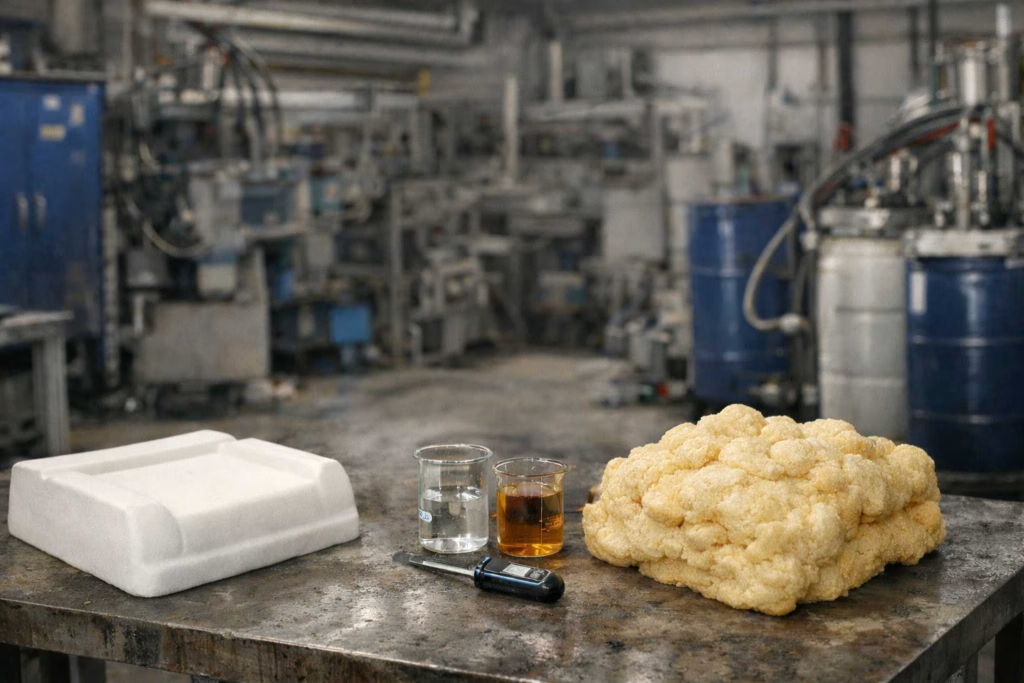
When designing polyurethane systems, one of the most frequent structural decisions polymer engineers and chemists face is whether to conduct the reaction in a single step (one-shot) or to incorporate a prepolymer stage into the process. Prepolymers are powerful chemical tools frequently preferred to maximize process control, tame reactivity, and guarantee the performance stability of the final product.
However, there is a common misconception in the industry: “Using a prepolymer always results in a better quality product.” This is not entirely true. The use of a prepolymer may not be necessary or economical for every polyurethane application. The correct engineering decision must be made by taking a holistic view of the application’s technical requirements, targeted mechanical performance, the precision of the machinery, and the production line conditions.
In this comprehensive guide, we will explore in detail what prepolymers are in polyurethane chemistry, at what points they add value to production processes, and in which situations they create unnecessary costs and process complexity.
1. What is a Prepolymer and What Does It Provide in Polyurethane Chemistry?
The foundation of the polyurethane reaction is the combination of isocyanate (-NCO) and polyol (-OH) groups. In a standard “one-shot” process, these two main components are mixed just before being poured or sprayed into a mold, and the entire polymerization reaction occurs within seconds or minutes inside the final product.
In the prepolymer approach, the process is split into two: A prepolymer is an intermediate product obtained by allowing the isocyanate component (MDI, TDI, etc.) to undergo a partial reaction with all or a portion of the polyol in the formulation in a reactor environment prior to the fabrication stage. As a result of this reaction, a stable liquid is obtained that still contains reactive isocyanate (-NCO) groups at the chain ends, but has an increased molecular weight and has reached a specific viscosity.
The Core Contributions of Prepolymers to a Formulation:
-
Reactivity Control: Since a portion of the reaction is completed beforehand in a laboratory/reactor environment, the mixing process performed by the end-user in the field proceeds more calmly, in a controlled manner, and with lower exothermic heat.
-
Homogeneous Phase Distribution: Microphase separation between the hard and soft segments of the polyurethane occurs much more uniformly. This ensures that mechanical properties are consistent throughout the material.
-
Reduction of Free NCO: By lowering the amount of free monomeric isocyanate in the formulation, it elevates occupational health and safety (OHS) standards and ensures compliance with environmental regulations (such as European REACH norms).
2. Applications Where Prepolymer Use is Advantageous and Critical
Prepolymer systems are unrivaled, especially in applications requiring high performance, zero fault tolerance, and excellent surface quality. In the industry group generally known as CASE (Coatings, Adhesives, Sealants, Elastomers), the use of prepolymers is almost a standard rule.
Elastomers and Special Casting Applications
When producing wheels, roller coatings, mining screens, or industrial parts with high abrasion resistance, mechanical expectations are at their peak. The use of a prepolymer ensures perfect alignment of the polymer chains. Excellent tensile, tear, and abrasion resistance are achieved. Furthermore, because the mixing ratio is much closer to a balanced state compared to one-shot systems (e.g., 100:100 or 100:80 instead of highly skewed ratios), it becomes much easier for dosing machines to weigh and mix the components homogeneously.
Adhesives and Sealants
In high-performance polyurethane adhesives and insulation sealants, the product’s tack time, initial grip (green strength), and flexibility are of critical importance. NCO-terminated prepolymers cure slowly and controllably with moisture in the air (1K systems), allowing them to penetrate surfaces perfectly.
Flow Control and Surface Quality
Prepolymers naturally have a higher viscosity. This prevents the material from leaking during potting or molding applications. It provides a longer working time (pot life) for the entrapped air to escape (degassing) during mixing, which prevents unwanted air bubbles (pinholes) and surface defects in the final product.
3. Situations Where Prepolymer Use is Unnecessary or Disadvantageous
A polyurethane system does not always need to feature the highest engineering performance; sometimes speed, lightness, and low cost take precedence over extreme durability. In these scenarios, using a prepolymer can actually hinder the process.
Standard Sponge and Foam Applications
Flexible block foams (bedding and furniture sectors) or rigid insulation foams (sandwich panels, spray foams) are generally produced in massive volumes. The primary goal of polyurethane in these systems is to achieve lightness and volume (expansion). Thanks to its high reactivity, the “one-shot” process handles gas evolution and polymerization simultaneously, allowing cell walls to form rapidly. Using a prepolymer in such systems slows down the material’s expansion and can disrupt the cell structure.
High-Volume Mass Production and Cost Pressure
Producing a prepolymer means an extra reactor, heating, mixing, cooling, and quality control process. This adds a significant process cost on top of raw material costs. On mass production lines that churn out thousands of items a day—such as automotive seat foams—and already yield excellent results with one-shot systems, using a prepolymer not only increases the unit cost of the product but also elevates the operational complexity of the system.
Spray Applications
In spray polyurethane or polyurea systems, the material is expected to react and cure the moment it leaves the gun and hits the surface (within seconds). The relatively higher viscosity and curbed reaction speeds of prepolymers can cause high-pressure proportioning machines to clog or result in the material running down vertical surfaces before curing.
4. Reactivity Control, Pot Life, and Storage Stability
The shelf life of a polyurethane formulation and the operational comfort it provides to the user are directly tied to the prepolymer strategy.
-
Extended Pot Life: Especially in manual casting workshops or when filling large molds, the material must not cure immediately. Because prepolymers calm the “wild” reactivity of the isocyanate, they offer the user a longer and safer working window.
-
Storage and Ambient Moisture Sensitivity: Isocyanates are highly sensitive to moisture and react with water to form carbon dioxide gas. Prepolymerized systems with reduced free NCO levels are less affected by ambient moisture while stored in drums. This extends the product’s shelf life and minimizes the risk of pressure buildup inside the barrel.
-
Low Exotherm: Because a portion of the reaction has already taken place when a prepolymer is used, the heat released (exotherm) during final molding is much lower. This prevents internal burning (scorch) or thermal shrinkage during the casting of thick-sectioned parts.
5. Decision Criteria: How to Choose a Prepolymer Strategy in Formulation?
To make the “right” decision in polyurethane system selection, the following criteria must be evaluated as a matrix. When deciding, these four main pillars should be reviewed:
-
Application Type and Expectation: Is the product an engineering elastomer that will carry heavy loads and be subjected to abrasion and tearing? (If yes, prepolymer). Or is it a lightweight building material intended to provide thermal insulation? (If yes, one-shot).
-
Process and Machinery Precision: Is the polyurethane injection machine on the production line sensitive enough to mix highly asymmetrical ratios like 100:2 accurately? If not, prepolymer systems should be preferred to bring the mixing ratio closer to 100:100.
-
Cost Tolerance: Does the final market possess the added value required to absorb the extra production and processing costs introduced by the prepolymer?
-
Occupational Health and Safety (OHS) Rules: If ventilation in the working environment is inadequate and there is a risk of volatile isocyanate vapors, the use of prepolymer systems containing low monomeric free NCO may become a legal and ethical necessity.
The Pluskim Approach: Optimal Solutions and Technical Guidance
In the polyurethane world, rote solutions often lead to inefficiency in the long run. Pluskim does not view prepolymer use as an industrial standard or a magic wand that solves every problem; rather, it considers it a highly application-specific, strategic technical tool.
When evaluating clients’ projects, Pluskim’s R&D and technical support teams focus on one core question: “How do we achieve the highest quality at the most optimal cost for this specific application?” While recommending cost-effective “one-shot” systems to avoid unnecessary process complexity when not required, they design tailor-made prepolymer systems with specific molecular weights for engineering projects where performance and tolerances are critical. The ultimate goal is always to deliver maximum benefit that is predictable, sustainable, and operator-friendly on the production line.
📩 To request prepolymer-based system solutions, custom system designs for your production line, and detailed technical evaluations, you can contact our expert team.