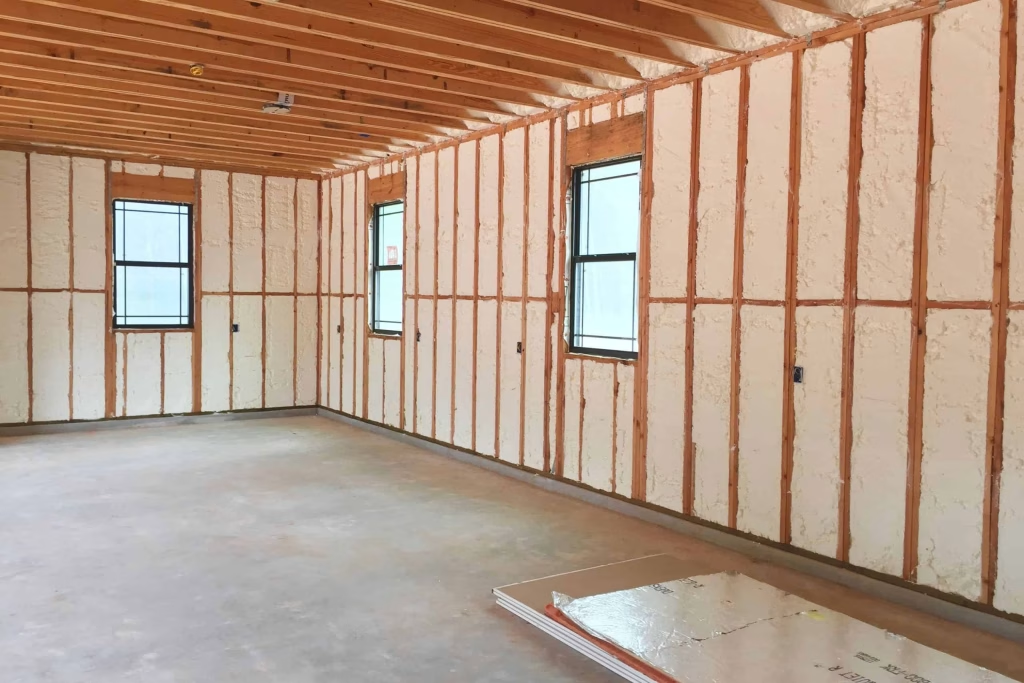
Closed-cell polyurethane systems are widely used in construction, industrial, and insulation applications due to their high thermal insulation performance, low water absorption, and strong mechanical properties. Thanks to their closed-cell structure, these materials provide excellent resistance to moisture while also contributing to energy efficiency in various insulation systems.
Despite these advantages, one of the most common technical issues encountered in field applications is surface cracking in closed-cell polyurethane. These cracks that develop after application are not merely aesthetic concerns. They can also affect the performance, water resistance, and long-term durability of the system.
In most cases, surface cracking cannot be attributed to a single cause. Instead, it typically results from a combination of reaction control, application conditions, formulation balance, and environmental factors.
Therefore, understanding surface cracking in closed-cell polyurethane systems requires evaluating both the chemical formulation and the application process together.
What is Closed-Cell Polyurethane?
Closed-cell polyurethane is a type of polyurethane foam in which the majority of the cells formed during the reaction remain closed. This closed structure provides low water absorption and superior insulation performance.
Closed-cell polyurethane systems are commonly used in applications such as:
-
Thermal insulation systems
-
Roof and terrace insulation
-
Cold storage insulation
-
Industrial tank and pipeline insulation
-
Waterproofing systems
For these systems to perform effectively, both the formulation parameters and the application conditions must be carefully controlled.
Why Does Surface Cracking Occur in Closed-Cell Polyurethane?
Cracks observed on the surface of closed-cell polyurethane generally appear after application or during the curing process. These cracks may initially occur at a micro level and may develop into larger structural cracks over time.
The most common causes are associated with the following technical factors.
1. Excessive Internal Stress Formation
Closed-cell polyurethane foams are formed through highly reactive chemical processes. During the reaction, gas generation and rapid expansion occur.
If this process is not properly controlled, internal stress can accumulate within the foam structure.
Over time, these stresses may manifest on the surface and lead to cracking, particularly in rigid systems. This effect may become more pronounced in formulations with a high closed-cell content.
2. Incorrect Reactivity and Gel Time
Reaction kinetics are a critical parameter in polyurethane systems. If the reaction proceeds too quickly, the foam may not have sufficient time to properly flow and level on the surface.
This may result in:
-
A brittle surface structure
-
Reduced elasticity
-
Non-uniform curing
Consequently, the risk of surface cracking in closed-cell polyurethane increases.
3. Inappropriate Ambient and Substrate Temperature
Environmental conditions play a significant role in closed-cell polyurethane applications. In particular, applications performed at low ambient or substrate temperatures can lead to premature curing at the surface.
Cold substrates may cause:
-
Sudden reaction termination at the surface
-
Curing differences between the inner and outer layers
-
Thermal stress formation
These factors can eventually lead to surface cracking in polyurethane insulation systems.
4. Imbalance in Additive Formulation
Additives used in polyurethane formulations directly influence the mechanical behavior of the system. Particular attention should be paid to the balance of additives such as:
-
Flame retardants
-
Fillers
-
Plasticizers
-
Stabilizers
Improper ratios of these additives may reduce the elasticity of the polyurethane system. Reduced elasticity lowers resistance to stress, increasing the likelihood of surface cracking.
5. Uncontrolled Application Thickness
One of the most common application mistakes in closed-cell polyurethane systems is applying excessive thickness in a single pass.
Thick applications may lead to:
-
Excessive heat accumulation during the reaction
-
Non-uniform curing
-
Differences in hardness between inner and outer layers
These conditions weaken the surface integrity and create conditions that may result in cracking.
How Can Surface Cracking Be Prevented?
Preventing surface cracking in closed-cell polyurethane systems requires careful control of both formulation parameters and application practices.
Key preventive measures include:
-
Proper adjustment of reaction speed
-
Controlled layer thickness during application
-
Maintaining suitable ambient and substrate temperatures
-
Balanced additive formulation
-
Homogeneous mixing and proper application equipment
Managing these factors collectively can significantly improve the long-term performance and durability of polyurethane insulation systems.
The Pluskim Approach
At Pluskim, surface integrity in closed-cell polyurethane systems is not addressed solely from a formulation perspective. Application conditions, reaction control, and environmental parameters are also considered as part of the system design.
This approach enables:
-
Development of more stable polyurethane systems
-
Reduction of surface cracking risks
-
Improved long-term performance in field applications
The objective is to provide polyurethane solutions that deliver reliable performance and long-lasting durability in real-world conditions.
For more information about closed-cell polyurethane solutions tailored to your application, please contact Pluskim.