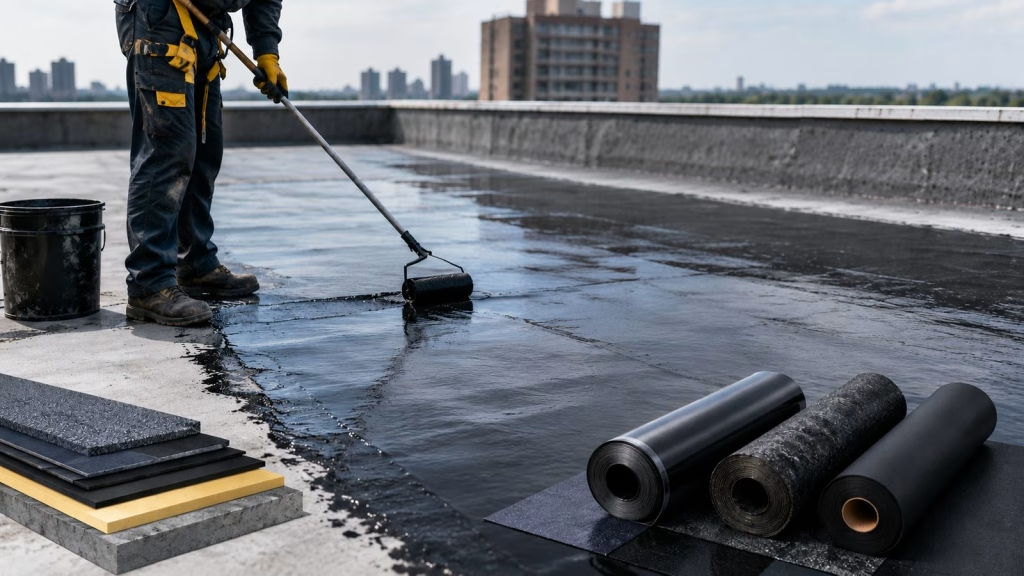
Used in waterproofing for decades and still one of the most widely specified solutions, a modified bitumen membrane corrects the weaknesses of pure bitumen through polymer modification. Chosen correctly it provides reliable protection across everything from flat roofs to basement walls; chosen incorrectly it cracks in the cold and flows in the heat. This article covers what a modified bitumen membrane is, the real difference between APP and SBS, where it is used, the four installation methods, and how it compares with liquid polyurethane systems.
What Is a Modified Bitumen Membrane?
Bitumen is highly waterproof but behaves poorly across temperature. In its pure form it softens and flows in summer and hardens and cracks in winter. Modification exists to correct both extremes: polymer is added to bitumen to widen its service temperature range.
In production, polymer-modified bitumen is coated onto both faces of a carrier layer. That carrier is the skeleton determining the mechanical strength of the membrane:
- Polyester fleece: High tensile strength and high elongation; preferred where structural movement occurs and crack bridging is expected,
- Glass fleece: Low elongation, high dimensional stability; used where movement is limited and the sheet must stay planar,
- Composite carrier: Combining both materials to target balanced behaviour.
The top surface varies with the application: thin film, sand, mineral granules (slate) or metal foil. Mineral-surfaced sheets provide UV protection on exposed roofs, while film-surfaced sheets are intended for applications that will receive a protective layer above.
In Europe the properties of roof waterproofing sheets are defined under EN 13707. For the institutional framework in which these standards are prepared, the resources of CEN-CENELEC can be consulted.
APP and SBS: Two Modifications, Two Behaviours
The first decision when selecting a modified bitumen membrane is which polymer it was modified with. There are two families and their behaviour differs markedly.
APP: Plastomeric Behaviour
Membranes modified with APP (atactic polypropylene) show plastomeric character. Their heat resistance is high; the softening point is raised significantly above that of pure bitumen. This makes them advantageous on sun-exposed roofs subject to prolonged high temperature in summer.
In return their flexibility at low temperature is limited. In cold climates or winter installation the membrane can become brittle, and folding or dressing details becomes harder.
SBS: Elastomeric Behaviour
Membranes modified with SBS (styrene-butadiene-styrene) behave elastomerically, meaning they tend to return to their original dimension after being stretched. They retain flexibility at low temperature and accommodate structural movement better.
That elasticity is a significant advantage in buildings with structural movement, high differential thermal expansion, or in seismic regions. Their high-temperature resistance, however, is more limited than APP.
Which One, Under Which Conditions?
The choice is made where climate and structural behaviour intersect:
- Hot climate, static structure: APP stands out; the risk of summer flow is low,
- Cold climate or moving structure: SBS stands out; it does not crack at low temperature and tolerates movement,
- Regions with harsh conditions in all four seasons: Carrier type and thickness can matter more than the polymer choice.
Two values on the technical data sheet must always be compared: cold bending temperature and heat resistance (flow) temperature. Together they define the real service window of the membrane.
Where It Is Used
Flat and Low-Slope Roofs
This is the most common application. On flat roofs where ponding can occur, two layers are usually installed: a base layer fixed mechanically or by adhesive, and a fully bonded mineral-surfaced cap sheet. The direction of laps is planned according to the drainage flow.
Terraces and Balconies
On terraces that will receive a finish, the membrane sits beneath a protective layer. The critical point here is that the screed poured or the finish laid above must not damage the membrane; a separation layer is commonly used.
Basements, Foundations and Retaining Walls
In structures exposed to groundwater the membrane forms a continuous barrier against water pressure. Laying a protection board before backfilling prevents the mechanical damage that occurs during filling.
Four Installation Methods
- Torch applied: The most common method. The underside of the membrane is heated with a torch and the melting bitumen acts as the adhesive. It is fast and provides strong adhesion, but because an open flame is used it carries serious fire risk on combustible substrates, timber roofs and at parapet upstands,
- Self-adhesive: Applied by peeling the release film from the underside. No flame is required, so it is preferred in fire-sensitive buildings and where work proceeds while the facility remains in use. Surface cleanliness and temperature are critical; adhesion weakens in the cold,
- Cold adhesive: A separate adhesive is applied and the membrane laid into it. It is flame free and gives good control at detail points; curing time must be built into the programme,
- Mechanically fixed: The membrane is fastened to the deck with screws and washers, with laps bonded. Used on large roofs where wind load is high; the watertightness of the fastening points must be resolved separately.
Whichever method is chosen, the rule on laps does not change: side laps are generally 8-10 cm and end laps 10-15 cm, with the manufacturer’s data sheet taking precedence.
Modified Bitumen Membrane Compared With Liquid PU
The two systems are often treated as alternatives. In reality they have different strengths and the decision depends on the project.
Strengths of a modified bitumen membrane: it is factory produced, so thickness is consistent and less affected by site workmanship; unit cost is generally lower; and because the system is widespread, finding experienced applicators is straightforward.
Its limits: rolls are joined on site at laps, and the majority of leaks begin precisely at those joints. Drains, pipe penetrations, corners and parapet upstands require cutting and adaptation. The torch method also carries fire risk.
Strengths of liquid polyurethane: applied as a liquid on site, it cures into a seamless single film with no joints; no cutting is needed at detail points; and it is cold applied with no flame.
Its limits: reaching the specified dry film thickness depends on applicator discipline, and control of ambient humidity and dew point is mandatory.
In practice there are also solutions combining both approaches. Bitumen Modified PU Liquid Membrane, which brings bitumen and polyurethane together in one system, is frequently chosen for refurbishment over existing bitumen membranes. For a fully polyurethane system there is 2K PU Based Waterproofing.
For a detailed comparison of the two systems, see our article Polyurethane Waterproofing or Bitumen Membrane?
Thickness, Number of Layers and Expected Service Life
After polymer type, thickness is the second decisive heading when selecting a modified bitumen membrane. Common thicknesses range from 3 mm to 4 mm; as thickness increases, both mechanical strength and the bitumen mass available as a reserve against ageing increase with it.
On flat roofs the general practice is two layers. A base layer is laid mechanically fixed or bonded, and a cap sheet is fully bonded, specified with mineral surfacing where it will remain exposed. Two layers are safer than one thick layer, because the laps of the two courses are offset so that a single defect cannot penetrate the whole system.
Expected service life is a combination of polymer type, thickness, UV protection and detail workmanship. Covered applications such as under terraces or below ground generally last longer because UV and thermal shock are removed from the equation. On exposed roofs the integrity of the mineral surfacing is decisive; wherever granules are lost the bitumen is directly exposed to UV and ageing accelerates.
Periodic inspection should therefore not be neglected. An annual visual check should examine laps for opening, the surface for blistering, areas of granule loss, and drain surrounds for detachment. A local defect caught early is solved with a patch, while the same defect left too long can require replacing the entire layer.
Common Mistakes in Selection and Installation
- Choosing the polymer without considering climate: APP in a cold region, or low heat-resistance SBS in a hot one, produces early failure,
- Disregarding the carrier: A glass fleece carrier in a moving structure can tear through insufficient elongation,
- Reducing lap widths: Shortening laps to save material is the most common cause of leaks,
- Applying to a damp or dusty surface: Adhesion will not establish; primer and surface preparation must not be skipped,
- Treating details like flat areas: Drain surrounds, corners and pipe penetrations require additional reinforcement,
- Using a torch on combustible surfaces: A flame-free method should be preferred over timber decks and insulation boards.
Conclusion
A modified bitumen membrane remains one of the established solutions in waterproofing thanks to its factory-controlled thickness, widespread installer knowledge and economical unit cost. Its performance rests on two decisions: a polymer type matched to climate and structural movement (APP or SBS), and a carrier matched to what the structure demands. On the installation side, lap widths, surface preparation and detail solutions determine the outcome.
On surfaces with complex detailing, in buildings where a flame cannot be used, or on refurbishment over an existing membrane, liquid polyurethane systems offer a strong alternative. For an introduction see What Is a Waterproofing Membrane? and for application detail see PU Waterproofing: Where to Use It and How to Apply It.
Contact our technical team to determine the waterproofing system best suited to the climate, structural movement and detail density of your project.