EPDM Binder: Choosing and Applying Polyurethane Binders for Rubber Surfaces
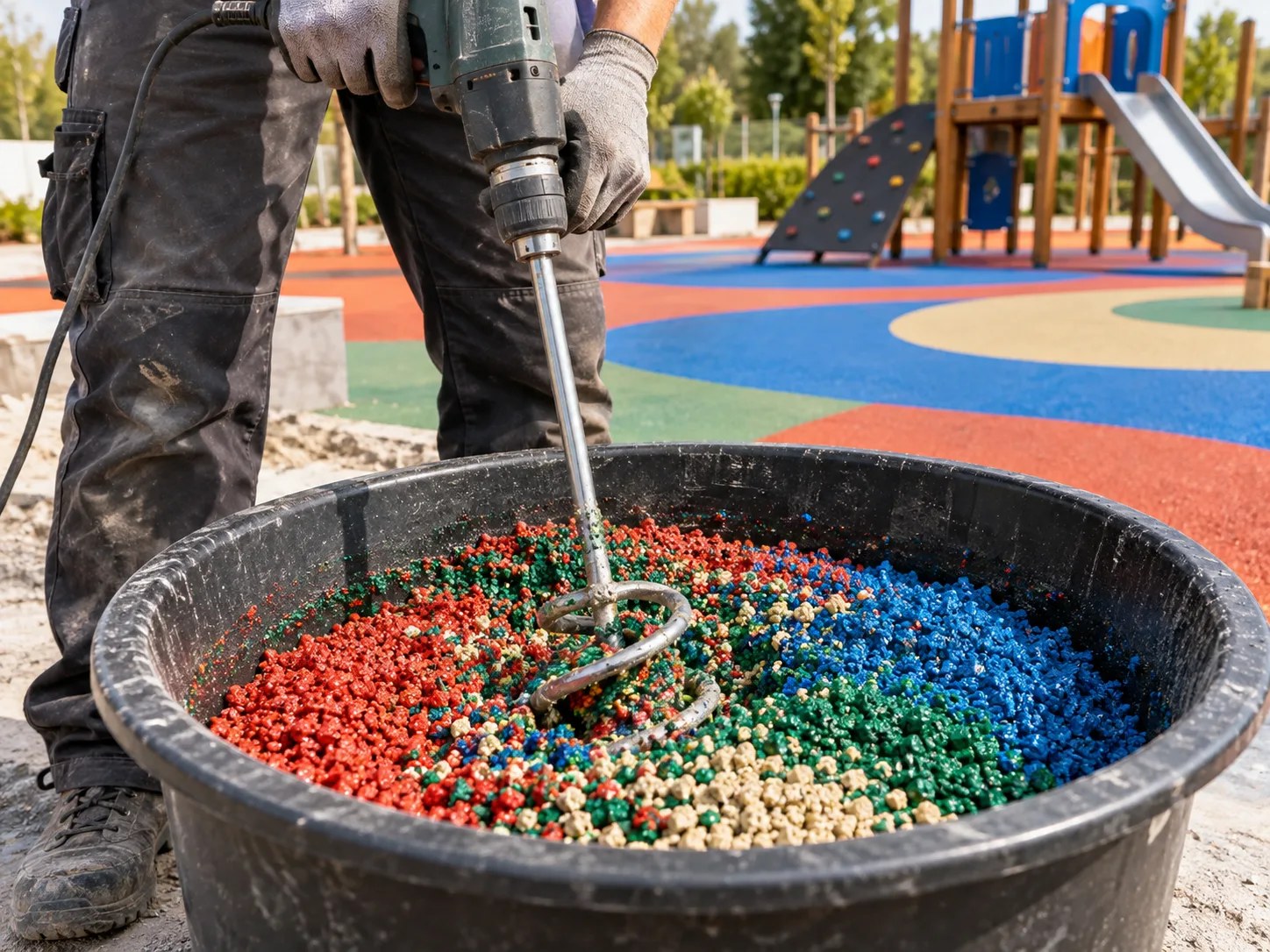
The soft surfaces in children's playgrounds, athletics tracks and the colourful paths in school grounds are all built on the same principle: rubber granules are held together by a binder and turned into a single, elastic, water-permeable surface. The binder, more than the granule, decides how long that surface lasts. In this article we explain how an EPDM binder system works, how the layers are built, the difference between aromatic and aliphatic binders, how to choose the right product and the most common mistakes on site.
What Is an EPDM Binder and How Does It Work?
An EPDM binder is a polyurethane-based system that coats the surface of rubber granules with a thin film and bonds them together at their contact points. The most common type is the one-component, moisture-curing binder: it reacts with moisture in the air, or with a small amount of water added to the mix, and forms an elastic polyurethane network.
The binder does not fill the voids between the granules; it only joins their contact points. This is what makes the finished surface both elastic and water-permeable, so rainwater drains through instead of pooling on top. Pluskim's PLUSNATE C-500 series is built this way: a solvent-free, aromatic, one-component polyurethane binder developed for EPDM and SBR rubber granules.
Where Is It Used?
- Children's playgrounds: Seamless, slip-resistant surfaces that absorb the impact of falls,
- Athletics tracks and sports fields: Track surfaces that need energy return and abrasion resistance,
- Walking and running paths: Coloured paths in parks, gardens and schools,
- Pool surrounds and terraces: Water-permeable surfaces that stay slip-resistant when wet,
- Stone carpet: Decorative floors in which natural stone or marble aggregates are bound together.
Layer Build-Up: SBR Base and EPDM Top Layer
Most rubber surfaces have two layers. The base layer is made of recycled SBR granules and provides the shock absorption; it uses coarser granules, and its thickness depends on the expected fall height or the sport. The top layer is made of coloured EPDM granules; it uses finer granules and forms the visible, wear-resistant and UV-resistant surface.
The binder content differs between the two layers. The finer granules of the top layer have a larger total surface area, so they need more binder. In practice the binder is dosed by granule weight; around 7-10 percent in the base layer and around 18-22 percent in the coloured EPDM top layer are common ranges. Because the right ratio depends on granule size, granule quality and the binder itself, the technical data sheet of the product in use should always be followed.
Aromatic or Aliphatic?
Polyurethane binders fall into two groups according to the type of isocyanate they use, and the difference matters most for colour:
- Aromatic binders: More economical, with high mechanical strength. They can yellow over time in sunlight; on dark, saturated granules the thin binder film is not noticeable, but it can show on light colours and in transparent applications. They are preferred for the SBR base layer and for most coloured EPDM top layers,
- Aliphatic binders: They keep their colour in UV light and do not yellow. They are used on light-coloured EPDM surfaces and in stone carpet, where the natural stone stays visible. Their unit cost is higher.
For light-coloured or transparent surfaces, Pluskim's 2K aliphatic stone binder and decorative stone and marble binders are developed for this need.
Criteria for Choosing the Right EPDM Binder
- Viscosity: The binder must flow well enough to coat every granule evenly; a binder that is too thick forms lumps, one that is too thin drains to the bottom,
- Open time and curing: The time available to spread and level the mix, and the time before the surface can take traffic, must suit the climate on site,
- Colour stability: The colour of the surface and its exposure to sunlight decide between aromatic and aliphatic,
- Mechanical values: Tensile strength and elongation at break matter so that the surface can flex without cracking,
- Solvent content: Solvent-free systems give a safer working environment in enclosed and semi-enclosed areas,
- Documents: Ask for a technical data sheet and safety data sheet for every product; also review system tests to standards such as EN 1177 for playgrounds and EN 14877 for sports surfaces.
For athletics tracks, the suitability of the surface system for international competition is certified separately; the detailed rules are in the World Athletics technical documents. We also discuss the performance expected in sports facilities in our article on polyurethane binders in Olympic sports facilities.
Application Steps
- Substrate preparation: The concrete or asphalt base must be sound, dry, dust-free and laid to falls; hollows where water would collect are corrected first,
- Primer: To improve adhesion to the base, the primer recommended in the data sheet is applied in a thin layer,
- Clean granules: Dust and fines on the granules absorb binder and weaken the bond, so clean granules should be used,
- Mixing: Binder and granules are weighed and mixed in a forced-action mixer until every granule is evenly coated. Only as much as can be laid within the open time is prepared,
- Spreading and compaction: The mix is spread to the required thickness with a screed and compacted with a trowel to finish the surface. A little release agent can be used to stop the trowel sticking,
- Curing: Moisture-curing systems cure more slowly in dry air; a fine water mist can speed up the process. Depending on conditions, curing usually takes between 12 and 48 hours.
Common Mistakes
- Too little binder: Granules break away from the surface and the floor starts to disintegrate,
- Too much binder: The voids close, the surface turns glossy and water permeability falls,
- Dusty granules: Part of the binder is spent on binding dust, which weakens the bond between granules,
- Laying in rain or low temperatures: Rain on an uncured surface can cause foaming and whitening of the binder,
- Aromatic binder on light colours: Light-coloured surfaces exposed to the sun change colour over time,
- Mix left standing too long: A mix past its open time does not compact well and leaves weak spots in the surface.
Maintenance and Repair
A correctly laid rubber granule surface needs little maintenance, but if it is neglected the pores fill up and the surface loses its water permeability. Regular care protects both its appearance and its shock absorption:
- Cleaning: Leaves, sand and dust should be swept or blown off regularly and, where needed, the surface washed with low-pressure water,
- Moss and dirt: Moss can grow in damp, shaded areas; the surface should be cleaned with suitable products that do not damage the binder,
- Inspection: Areas showing loose granules, lifting or sinking can be fixed with small repairs if they are noticed early,
- Repair: The damaged area is cut out with clean edges, the edges are primed, and the hole is filled with a mix of the same granule and the same binder.
Using the binder type and ratio of the original installation keeps the new patch at the same elasticity and colour as the surrounding surface.
Conclusion
The strength, elasticity and appearance of a rubber granule surface depend largely on the choice of binder and on discipline during application. The right ratio for each layer, the right binder type for the colour of the surface, clean granules and suitable weather are the basis of a floor that performs for years.
You can explore our PLUSNATE C-500 series binders for EPDM and SBR granules and our EPDM flooring and tartan system adhesives. Contact our technical team to choose the right binder type and ratio for your project and to request a data sheet and sample.
Let us specify the right system for your line
Tell us your application, line type and target density; our technical team will reply with a formulation proposal.