Waterproofing Membrane Manufacturer: What to Look for When Choosing a Supplier
Two membranes with the same name can perform very differently on site, and the reason is usually the production behind the label. How the raw materials are chosen, the conditions in which the mix is made and how each batch is checked decide how the product will behave on a roof years later. That is why, when you evaluate a waterproofing membrane manufacturer, you need to look at the plant that produces the data sheet, not only at the data sheet itself. In this guide we explain how to tell a manufacturer from a reseller, how membranes are made, how to assess a manufacturer in six steps, how to build a simple scoring table and which questions to ask on a factory visit.
We cover the general supplier criteria, total cost and a pre-contract checklist in our waterproofing material supplier guide. This article focuses on evaluating the manufacturer itself.
Manufacturer or Reseller?
Some companies selling waterproofing membranes produce them themselves; others distribute, or sell under their own brand, a product made in another plant. Working with a reseller is not always wrong, but it makes a difference in three areas:
- Control of the formulation: When a product has to be adjusted for a climate, substrate or application method, only the manufacturer can make that change,
- Traceability: In a complaint, only the manufacturer can show which raw material batch was used and the production records behind it,
- Technical contact: The team that can analyse a problem in the laboratory and propose a solution sits with the manufacturer.
Ask the company directly whether it produces the product itself and, if so, where its plant is. A vague answer about the production site is the first warning sign of the evaluation.
How Are Waterproofing Membranes Made?
Knowing the production process tells you what to look for in the plant. The two main product groups are made in different ways.
Liquid-Applied Polyurethane Membranes
One-component polyurethane membranes are usually prepolymer-based and cure with moisture from the air. That makes moisture control the most critical point in production: fillers are dried, mixing takes place in a closed, dry environment and the product is filled without contact with moisture. A small amount of moisture let in during production comes back as gelling in the container or foaming on site. Viscosity, density, NCO content and drying time should be measured for every batch. We cover how these products are applied in our PU waterproofing guide.
Bituminous Sheet Membranes
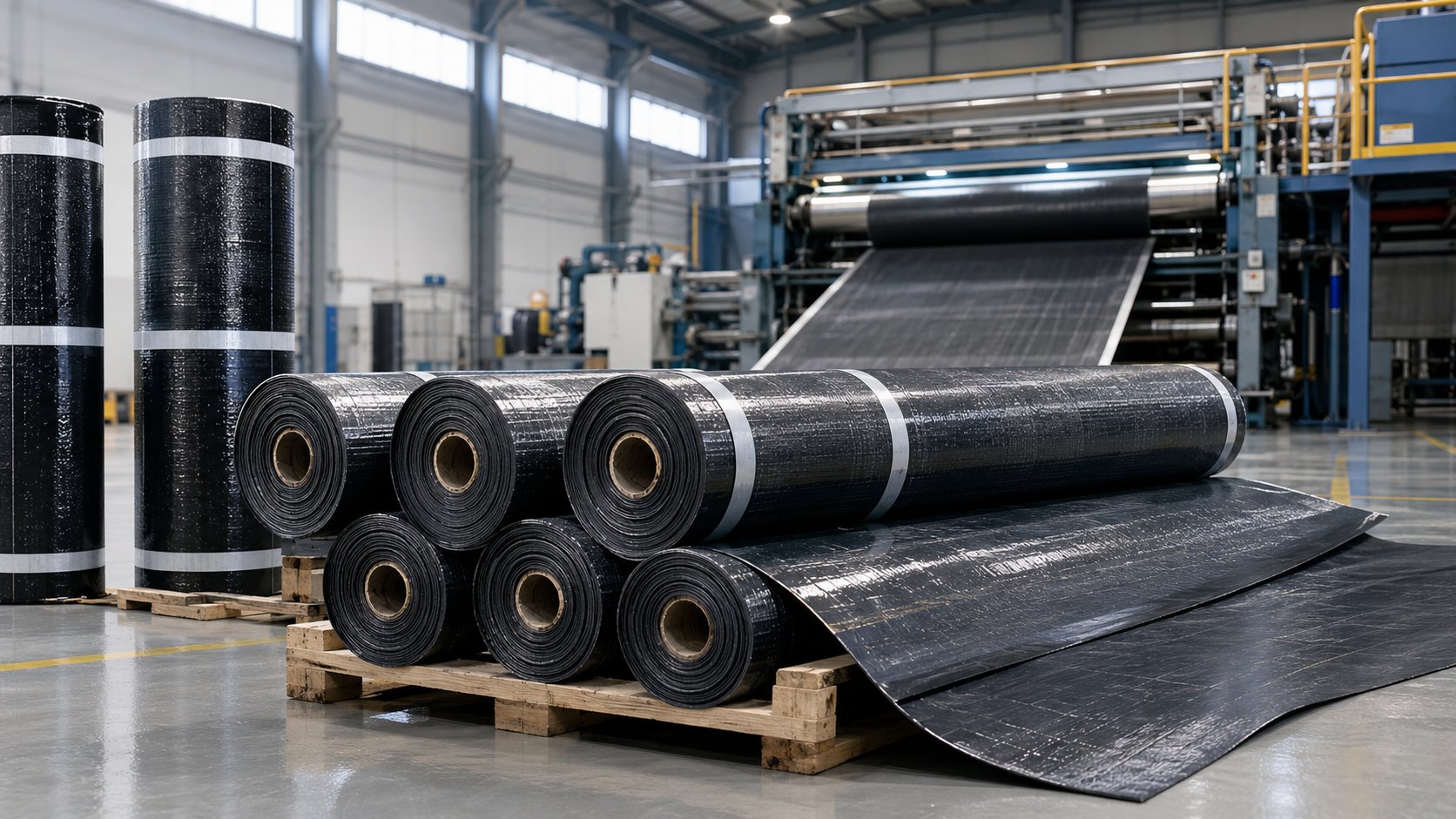
In sheet membranes, bitumen is modified with polymers such as SBS or APP and coated onto a polyester or glass-fibre carrier. Thickness, carrier type, polymer content and cold flexibility are monitored continuously on the production line. We compare the sheet systems in our article on waterproofing membrane types.
6 Steps to Evaluate a Waterproofing Membrane Manufacturer
1. See the Production Facilities in Person
Seeing a plant tells you far more than a catalogue. During the visit, look at the conditions in the raw material store, the mixing and filling equipment, how the product is protected from moisture and the packaging line. Check whether the site has its own quality control laboratory and whether a sample is taken from every batch produced. If a visit is not possible, ask for a video tour of the production area and the laboratory.
2. Read Test Reports Correctly
A test report is only worth something if it is read correctly. When you review one, look for the answers to these questions:
- Who carried out the test: The manufacturer's own laboratory or an independent one? For independent laboratories, ISO/IEC 17025 accreditation and its scope matter,
- Which product was tested: Do the product name and code in the report match exactly the product you have been offered?
- Which system was tested: Was the membrane tested on its own, or together with its primer and top coat?
- When was it tested: Does the report date from before a change in the formulation?
- Against which standard: Are the test method and standard number clearly stated in the report?
In Europe, the accreditation of laboratories can be checked through the national accreditation bodies that belong to European Accreditation.
3. Ask for the Quality Control Plan
A serious manufacturer does not leave quality to a single final check. Ask for a written plan showing how incoming raw materials, intermediate products during production and the packaged final product are checked. Ask whether a certificate of analysis with a batch number comes with every delivery, whether a retained sample is kept from every batch and for how long. A retained sample is the most reliable way to tell whether a problem on site comes from production or from application.
4. Test Capacity and Lead Times
A manufacturer's total capacity does not mean it can supply you exactly when you need it. In the construction season, demand piles up in the same months. Find out how lead times change in peak periods, whether stock is held for critical raw materials and whether there is an alternative source if a raw material becomes scarce. On large projects, sharing the production plan against delivery dates in advance reduces this risk.
5. Gauge Formulation Flexibility and R&D Strength
An off-the-shelf product may not fit every project. You may need faster curing in a cold climate, a different colour, a viscosity suited to spraying or production under your own brand. Ask whether the manufacturer has an R&D team that can assess such a request, whether it can run pilot production and trials, and whether it ever changes a formulation without telling the customer. Advance notice of formulation changes should be a written commitment.
6. Assess Technical Documentation and Site Support
The quality of the documentation shows how well a manufacturer knows its product. The Technical Data Sheet should state test methods, the Safety Data Sheet should carry the current classification, and the application instructions should give detail from surface preparation to recoat intervals. For products sold as construction products, ask for the declaration of performance as well. Beyond the documents, ask whether a technical team attends the first application and trains the crew.
A Simple Scoring Table
When comparing several manufacturers, decide on the same scale rather than on impressions. Score each heading from 1 to 5 and multiply by its weight. The weights below are an example; adjust them to the priorities of your project:
- Test documents and product performance: 30%,
- Production facilities and quality control: 20%,
- Technical support and documentation: 20%,
- Capacity and delivery reliability: 15%,
- Total cost per square metre: 15%.
Price is deliberately not the deciding factor on its own. A low price from a manufacturer with weak documents or uncertain deliveries does not cover the risks that will appear later in the project.
Questions to Ask on a Factory Visit
- Do you produce this product in this plant, or is it made under contract elsewhere?
- Which checks do raw materials pass before you accept them?
- Which values do you measure for each batch, and how do you keep the results?
- How long do you keep retained samples?
- Has the formulation of this product changed in the last year?
- How does your standard lead time change in the peak season?
- Who runs the investigation when a complaint comes in, and how long does it take?
- Can we see applications carried out in similar conditions?
Warning Signs
Proceed with more care if you come across any of the following during the evaluation:
- Report and product do not match: The product name or code in the test report differs from the product offered,
- Values without methods: The data sheet lists values but not the standard they were measured to,
- No batch documents: No certificate of analysis can be provided with deliveries,
- Sample and series production differ: The product that impressed in the trial behaves differently in the first delivery,
- Price is the only topic: Discussions focus on discounts instead of answering technical questions.
Conclusion
A good waterproofing membrane manufacturer does not only present its product; it can show how the product is made and how it is checked. Seeing the plant in person, reading test reports correctly, asking about the quality plan and retained samples, and comparing offers with the same scoring table reduce the risk of a waterproofing system that has to last for years.
Pluskim is a polyurethane system house that has been producing polyurethane systems at its plant in Istanbul since 2009. You can learn about our R&D and laboratory facilities on our R&D page and explore our liquid membrane and coating systems on the Coatings and Waterproofing page. Our UV-resistant PU liquid membrane for exposed surfaces and our bitumen-modified PU liquid membrane for foundations and wet rooms are among our key products. Contact our technical team to visit our plant or to request a data sheet and sample.
Let us specify the right system for your line
Tell us your application, line type and target density; our technical team will reply with a formulation proposal.