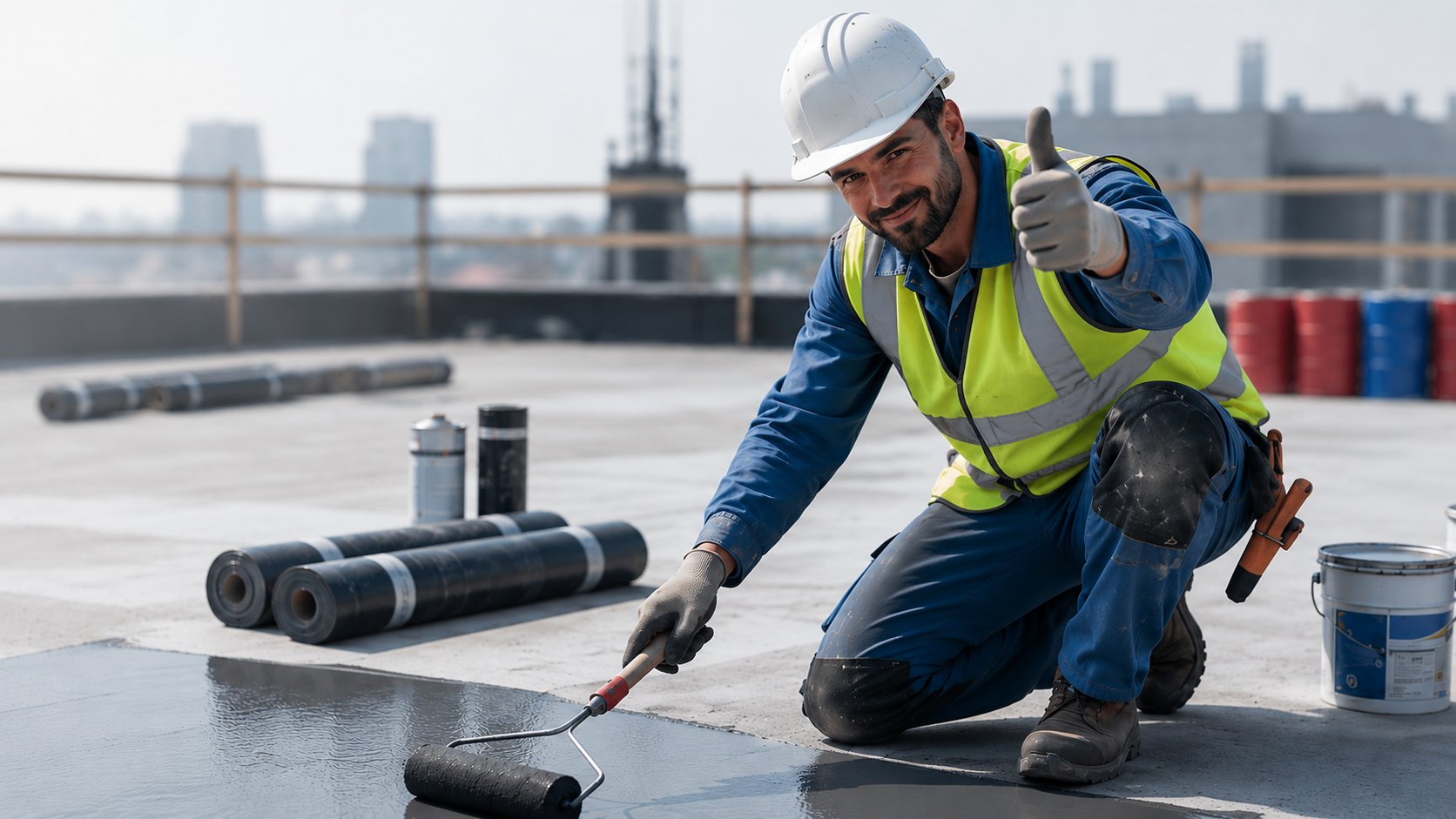
How to Choose a Waterproofing Material Supplier: A Practical Guide
When waterproofing fails on a roof or a foundation, the cost rarely stops at the material invoice. Removal, reapplication, lost working days and damage to the structure quickly outweigh any price difference from the original purchase. That makes choosing a waterproofing material supplier more than a purchasing decision: it is a technical decision that sets the risk of the whole project. In this guide we cover how to define your requirements, the seven criteria to use when evaluating a supplier, how to calculate total cost and which questions to ask before signing.
Start by Defining the Requirement
Writing down the project conditions before you speak to suppliers lets you compare quotations on the same basis. A request for "waterproofing material" is too general, because the same product does not perform the same way on every surface. Before asking for a quotation, make these points clear:
- Application area: Roofs, terraces, foundations, wet rooms, water tanks and car parks each work under a different load,
- Substrate: Concrete, metal, wood or an old coating; its moisture and condition determine the primer,
- Exposure: Sunlight, constant contact with water, foot or vehicle traffic, roots and chemicals,
- Application method: Brush, roller, trowel or spray; crew experience and available equipment also matter,
- Expected life and maintenance: The target service life and the plan for renewal or top coats.
If you are new to the differences between materials, our articles on waterproofing membrane types and polyurethane versus bitumen are a good place to start.
7 Criteria for Choosing a Waterproofing Material Supplier
1. Product Range and System Approach
Waterproofing is rarely a single product. Primer, main coat, joint and detail materials and, where needed, a UV-resistant top coat work together as a system. Sourcing these layers from different places raises the risk of incompatibility and leaves responsibility unclear when a problem appears. Ask which primer and top coat the proposed product has been tested with. A supplier that offers the whole system brings compatibility and technical responsibility to one point.
2. Technical Documents and Test Standards
Look for measured values rather than general brochure claims. A Technical Data Sheet should at least state elongation at break, tensile strength, hardness, adhesion, consumption, curing times and application temperature. It should also state the test method behind each value; without the method, the figures of two products cannot be compared.
The main references used in Europe are:
- EN 1504-2: Coating systems used for the surface protection of concrete,
- EN 14891: Liquid-applied waterproofing products used beneath ceramic tiling,
- EAD 030350-00-0402: The European Assessment Document for liquid-applied roof waterproofing kits,
- EN 13707: Reinforced bitumen sheets for roof waterproofing.
When you receive a certificate, check three things: is it issued for this product, is it still valid and does the test cover your application? The current list of standards is available through CEN-CENELEC, and European Assessment Documents through EOTA. Quality management certificates such as ISO 9001 show how production is organised, but they do not prove the waterproofing performance of a product on their own.
3. Production Control and Batch Consistency
A good sample does not prove that every delivery will match it. Ask how the supplier checks incoming raw materials, whether it issues a certificate of analysis for each batch and whether it can trace a product back through its batch number. Deviations in viscosity, density and curing time show up on site as application problems. A supplier that produces in its own plant and controls its formulation can usually keep a closer watch on this.
4. Total Cost Instead of Unit Price
The price per kilogram is misleading on its own, because products do not deliver the same protection with the same quantity. The right comparison is per square metre and over the service life. This illustrative calculation shows the difference:
- Product A: 10 units per kilogram, consumption 2.0 kg/m². Material cost 20 units/m²,
- Product B: 12 units per kilogram, consumption 1.5 kg/m². Material cost 18 units/m².
In this example, the product that costs more per kilogram is cheaper per square metre. The calculation should also include primer and auxiliary materials, labour for the number of coats and waiting times, waste, product lost to expired shelf life, and the frequency of maintenance and renewal. The cost of a possible repair is usually far higher than the difference in material price.
5. Technical Support and Application Training
Many waterproofing problems come not from the material but from surface preparation and application conditions. That is why it matters who stands beside you after the sale. Find out whether the supplier advises on substrates and product choice, attends the first application, trains the application crew and takes samples for laboratory analysis when a complaint arises. We cover the application details in our PU waterproofing application guide.
6. Continuity of Supply and Logistics
A site programme depends on material arriving on time. Clarify standard lead times, products held in stock, minimum order quantities and packaging options in advance. Shelf life and storage temperature also belong here: polyurethane systems are sensitive to moisture and opened packaging should be used quickly. On large projects, planning partial deliveries instead of a single shipment prevents the product from ageing in storage.
7. Regulatory and Safety Documents
Ask for a current Safety Data Sheet in the local language for every product. Check the obligations under REACH in the European Union and KKDIK in Türkiye. For polyurethane systems containing isocyanates, a diisocyanate training requirement applies to professional users in the EU. Where a product is placed on the market as a construction product, also ask about CE marking and the declaration of performance.
Questions by Material Type
The seven criteria apply to every material, but some questions matter more for certain product types:
- Polyurethane liquid membrane: Is it one or two components, and what are its elongation and UV resistance? See our UV-resistant PU liquid membrane for exposed surfaces and our 2K PU waterproofing for brush-applied work,
- Bitumen-modified system: What thickness is applied in foundations and wet rooms, and what can it be covered with? Our bitumen-modified PU liquid membrane is an option for these areas. We compare sheet systems in our modified bitumen membrane article,
- Polyurea: What equipment does it need, how quickly does it cure and what are the application conditions? For projects that demand high strength, see our pure polyurea systems.
Samples and Trial Application
On paper, two products can look very close. Before deciding, apply a small trial area on your actual substrate. Observe adhesion, consumption, curing time, ease of application and the transition between coats. The trial means more when it is carried out in conditions close to those of the project and by the crew who will do the work. Record the sample's batch and the results, so you can compare later deliveries against them.
Pre-Contract Checklist
Before agreeing terms with a waterproofing material supplier, get written answers to these questions:
- Are the Technical Data Sheet, Safety Data Sheet and test reports current and issued for this product?
- Will a certificate of analysis and batch number come with every delivery?
- Have the primer, main coat and top coat of the proposed system been tested together?
- Which thickness is the consumption per square metre based on?
- What are the lead time, minimum order, packaging and remaining shelf life?
- Is site support and crew training provided for the first application?
- How does the complaint investigation work, and who is responsible?
- What does the warranty cover, and how are application errors separated?
- Will you be notified in advance of any change in formulation?
Conclusion
The right supplier is not the one with the lowest price per kilogram. It is the one that documents its measured values, delivers the same quality in every batch and stands behind you on site. Defining the requirement in writing, comparing offers per square metre and over the service life, and running a small trial application will prevent surprises that cost far more later.
You can explore our polyurethane, polyurea and liquid membrane systems on the Coatings and Waterproofing page, and our construction systems on the COAT Series page. Contact our technical team to choose the right system for your project and to request a data sheet and sample.
Let us specify the right system for your line
Tell us your application, line type and target density; our technical team will reply with a formulation proposal.